Weeks
Not a year
From EPC handover pack to a structured, executable project model your engineers have confirmed.
AI Population
Deskely's AI reads the handover documentation, removes the duplicates, classifies what is left, and clusters it into systems and subsystems — so project setup takes weeks instead of a year.
Engineer-confirmed setup · Nothing goes live unapproved
From EPC handover pack to a structured, executable project model your engineers have confirmed.
Duplicate tags and documents spread across handover packages are collapsed into a single source of truth.
Template design, assignments, and sign-off flows are always approved by senior engineers before go-live.
The Problem
An EPC handover pack is not a project model. It is thousands of files produced by different contractors, at different times, under different conventions — tag registers, system breakdowns, vendor packages, and index exports that were never designed to agree with each other.
Turning that into something a commissioning team can execute against means deduplicating tags that appear five times in four formats, deciding which description is authoritative, assigning every tag to a system and subsystem, and mapping the whole structure to a completions model. On a large capital project this routinely absorbs the better part of a year of senior engineering time.
Until it is finished, nothing downstream can start. No checksheets, no preservation schedules, no walkdowns, no certificates.
How it works
Load EPC handover documents, registers, and supporting files that describe the project scope.
AI pulls out tags, documents, and metadata, removing duplicates that commonly appear across handover packages.
Tags and documents are classified and grouped into systems, subsystems, disciplines, and scopes.
The clustered data is organized into Deskely's master data model, ready for template assignment.
Senior engineers confirm template design, assignments, and sign-off flows before field execution begins.
Systems, subsystems, and scopes are live in Deskely — ITRs, preservation, walkdowns, and certificates can start immediately.
What Gets Resolved
The same tag appearing in the EPC index, a vendor package, and a contractor register under three different formats
Leading zeros, spacing, and prefix variants that make identical tags look like separate assets
Tags that arrive with no system or subsystem reference at all
Competing descriptions for one tag, where a decision is needed on which source is authoritative
Documents attached to the wrong asset, or to an asset that does not exist in the register
The output is not a cleaned spreadsheet. It is a structured project model — systems, subsystems, disciplines, and scopes — that the rest of Deskely can immediately execute against, with anything ambiguous routed to a review queue rather than guessed at.
Engineers Stay in Control
Population is deliberately human-in-the-loop. The AI proposes a project structure; it does not commit one. Senior engineers confirm the system and subsystem breakdown, approve merge decisions where duplicates were collapsed, and resolve anything the model flagged as uncertain.
Three things are never automated: template design, template assignment, and sign-off flows. Deciding which ITRs apply to which tags, and who is authorised to sign them, is an engineering judgement with contractual weight — so it stays with your team.
Every proposal, acceptance, and override is logged against the user who made it, which is what makes the resulting dataset defensible at handover.
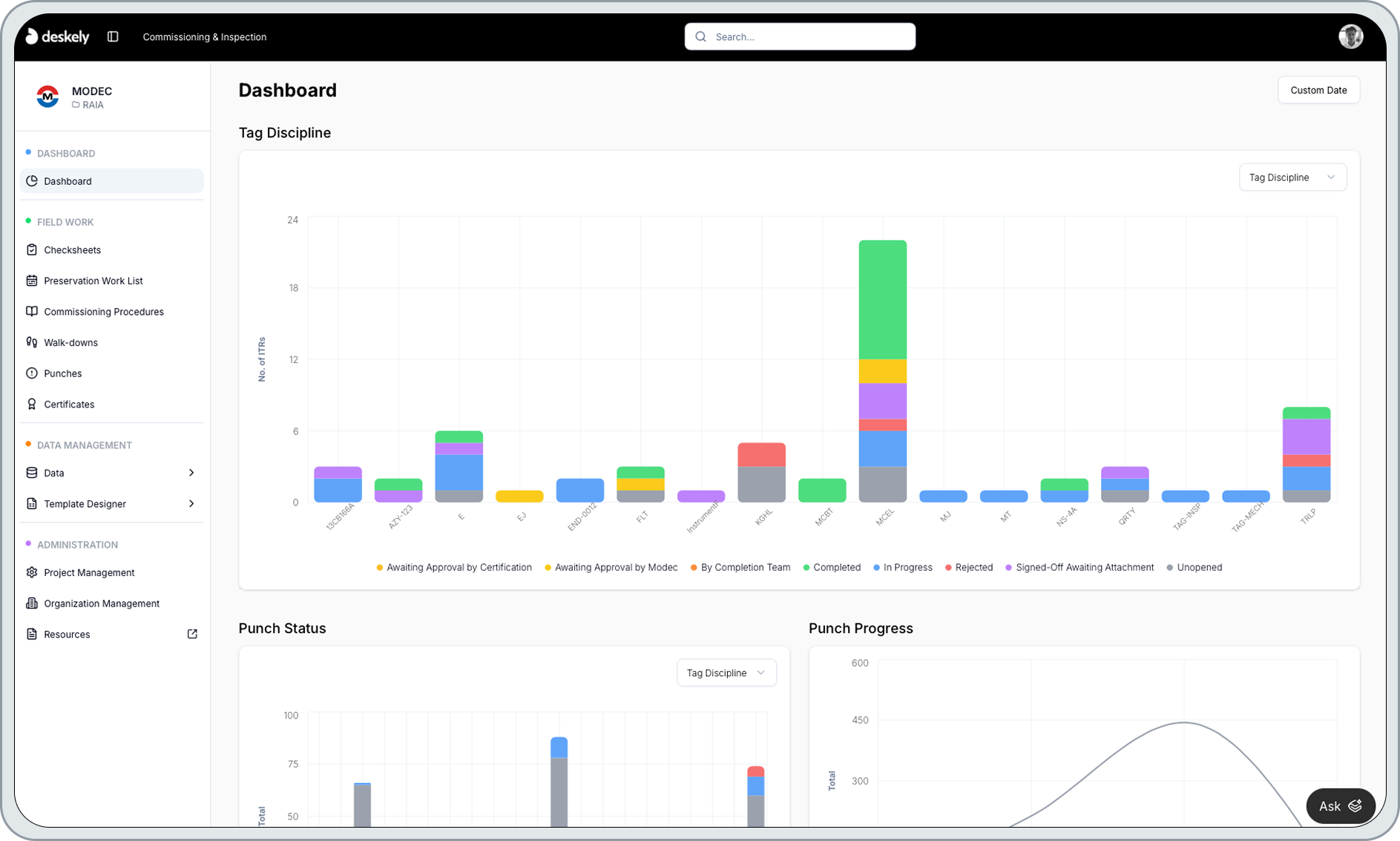
Project setup in weeks, not a year. Reduce the time to move from EPC handover to a structured, executable project model.
Clean, consistent project data. Deduplication and classification reduce the data-quality issues that delay commissioning closeout.
Human authority preserved. Template design, assignments, and sign-off are always confirmed by senior engineers before going live.
Connects to every execution module
Once confirmed, populated data flows into ITR, PWL, CP, Walkdowns, Punch, and Certificates.
Designed for large capital projects
Built to handle the volume and complexity of offshore energy and manufacturing project handovers.
Business Outcomes
Project setup stops being a year-long front-end activity that blocks every commissioning workstream behind it.
Senior engineers spend their time confirming structure and designing templates, not reconciling registers by hand.
Duplicates and misclassifications are resolved at setup, where they cost minutes, instead of in the field.
The dataset the operator receives is clean and traceable because it was built that way from the first import.
FAQ
We use cookies to improve your experience.
You can opt out of certain cookies.
Find out more in our privacy policy.