Valve test certificate: free template for shell and seat tests (Excel and PDF)
Deskely Completions team Singapore
A valve test certificate records the pressure tests a valve passed: the shell test of the body, the backseat test where there is one, and the closure (seat) tests in both directions. Valves are tested by the manufacturer, and many projects retest them at site before installation.
This page gives you a free valve test certificate in Excel and PDF, with a register for site testing, and explains the tests in API 598.
- The shell test proves the body and bonnet; the closure test proves the seat.
- API 598: shell at 1.5 times the 38 °C rating, high-pressure closure at 1.1 times.
- Low-pressure closure tests use air or gas at 4 to 7 bar.
- Test durations and allowed leakage depend on the valve size and type.
The tests in API 598
| Test | Pressure | What it proves |
|---|---|---|
| Shell test | 1.5 times the rated pressure at 38 °C, with water | Body, bonnet and their joints do not leak or deform; no visible leakage is allowed. |
| Backseat test | 1.1 times the rated pressure at 38 °C | The stem backseat seals, where the valve has one. |
| High-pressure closure test | 1.1 times the rated pressure at 38 °C | The seat seals at full differential pressure, tested from each side where the valve seals both ways. |
| Low-pressure closure test | Air or inert gas at 4 to 7 bar (60 to 100 psi) | The seat seals at low differential pressure, where soft seats and some metal seats can leak. |
API 598 sets the minimum test durations by valve size and the allowed seat leakage by valve type and seat material; ISO 5208 is the international equivalent. Your specification may ask for more. See valve types for the valves themselves.
The template
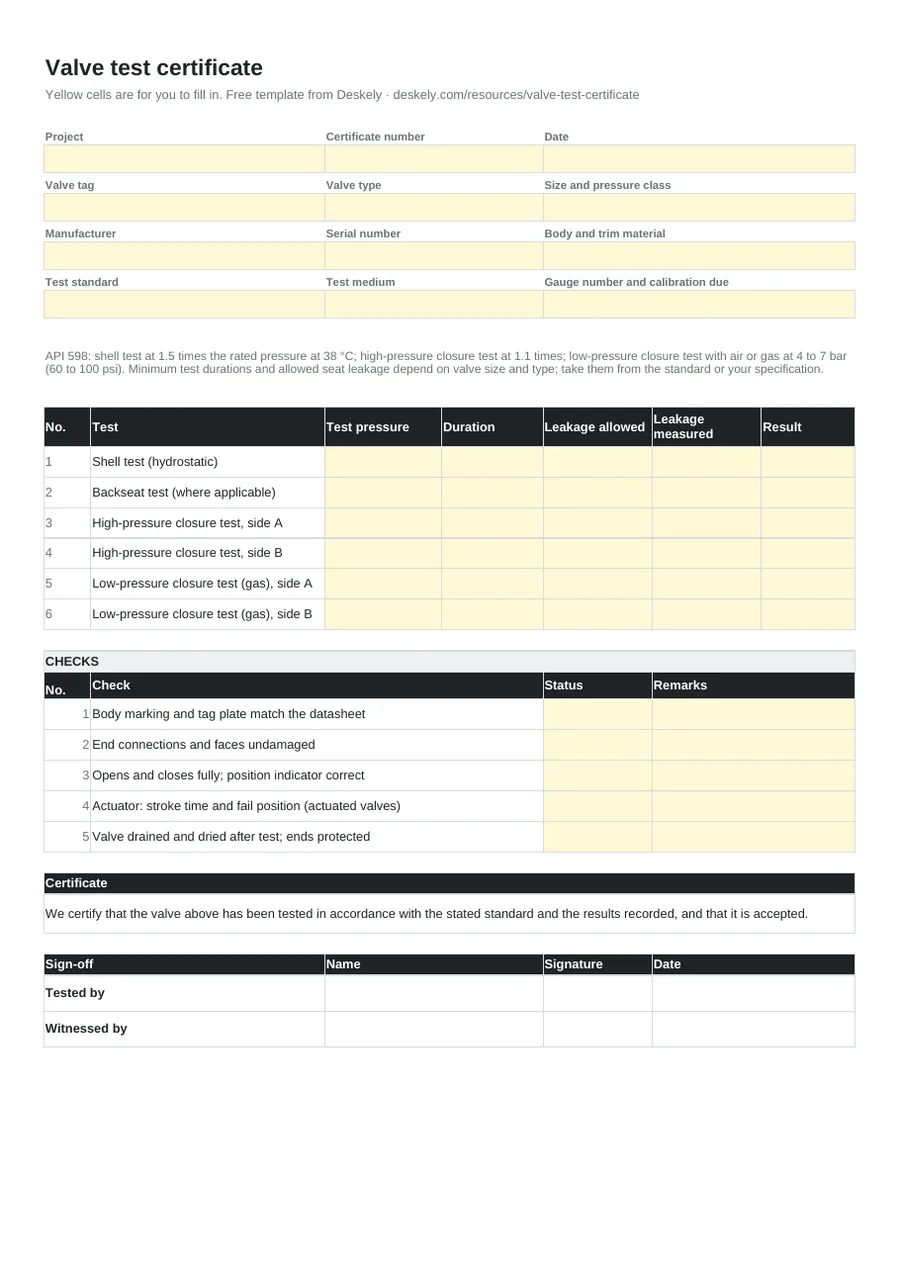
The certificate covers one valve: its identification, each test with the pressure, duration, allowed and measured leakage and result, the functional checks, and the signatures. The register keeps one line per valve tested at site.
Site testing and handover
Valve certificates are part of the quality records in the handover dossier, and actuated valves get a stroke test and fail-position check again during pre-commissioning.
In Deskely, test records are held against the valve's tag, so missing certificates show on the subsystem before mechanical completion.
The Deskely products for this
Frequently asked questions
What is a valve test certificate?
A record of the pressure tests a valve passed (shell, backseat and closure tests) with the pressures, durations, leakage and signatures.
What is the shell test pressure for a valve?
Under API 598, 1.5 times the valve's rated pressure at 38 °C.
What is the difference between a shell test and a seat test?
The shell test pressurises the body to prove it does not leak. The seat (closure) test pressurises one side of the closed valve to prove the seat seals.
Which standard covers valve testing?
API 598 is the most widely used; ISO 5208 and the product standards (such as API 6D) also set test requirements.
- In production since 2014
- Thousands of daily users
- On MODEC FPSO projects since 2016