Inspection and test plan (ITP) template: free Excel download, with hold and witness points explained
Deskely Completions team Singapore
An inspection and test plan (ITP) lists every inspection and test a piece of work goes through, in the order it happens, with the document it is checked against, the acceptance criteria, the record that proves it and who has to be there. It is agreed before the work starts, and it is how the client and the third party inspector plan their visits.
This page gives you a free ITP template in Excel and PDF, filled in with a worked example for piping fabrication and installation, and explains hold and witness points and how to write an ITP for your own scope.
- An ITP sets out every inspection and test, in sequence, before the work starts.
- Each line names the reference document, the acceptance criteria and the record that proves it.
- Hold points stop the work until released; witness points are notified but do not stop it.
- The records the ITP calls for are what end up in the handover dossier.
What is an inspection and test plan?
An ITP is a quality document that turns the specification into a sequence of checks. For each activity it states what is inspected, against which document, what counts as acceptable, which record is produced, how often, and what each party (contractor, client, third party inspector) does at that step.
ITPs are written per discipline or per work package: piping fabrication, structural steel, electrical installation, a vendor's package. They sit under the project quality plan, and the inspection and test records (ITRs) are the forms filled in when each ITP step is carried out.
Hold, witness, review and surveillance points
| Code | Meaning | Does work stop? |
|---|---|---|
| H: Hold point | The party must inspect and release the work before it continues. | Yes, until released |
| W: Witness point | The party is notified in advance and may attend. If they do not come, work goes on. | No |
| R: Review | The party reviews the records (certificates, reports) rather than attending. | No |
| S: Surveillance | The party carries out spot checks at its own discretion. | No |
Hold points belong where a mistake would be expensive or impossible to find later: material release before fabrication, the test pack review before a pressure test, a pressure test itself for the client. Too many hold points stall the job; too few move the risk to the end.
The template
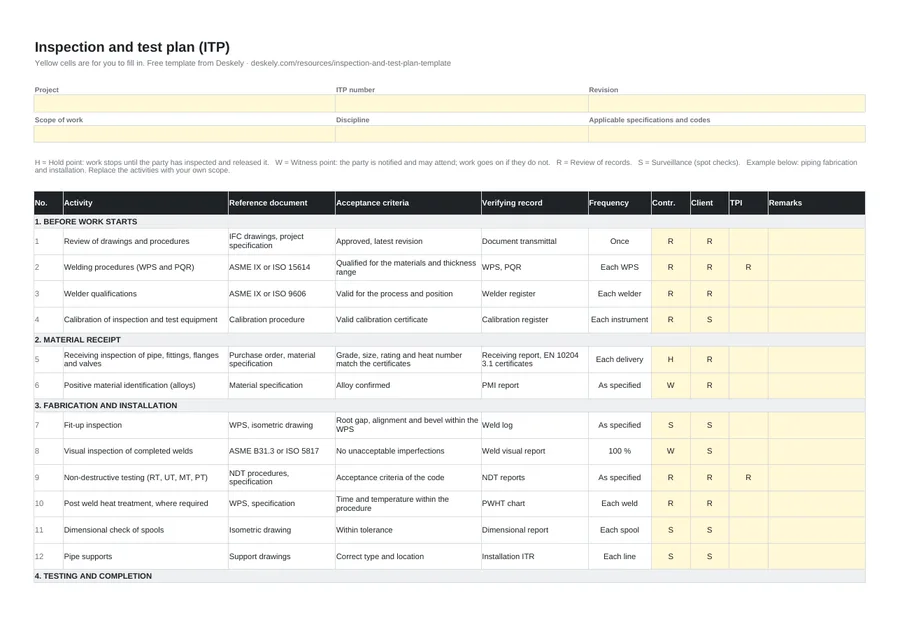
The columns follow the usual ITP layout: activity, reference document, acceptance criteria, verifying record, frequency, and an inspection code for the contractor, the client and the third party inspector. The worked example runs from document review and welder qualification through material receipt, fit-up, welding, NDT and PWHT, to the pressure test, reinstatement, coating and final documentation.
How to write an ITP
- 01Start from the specification
List every inspection and test the specification, the codes and the contract require for the scope.
- 02Put them in sequence
Order the activities as the work happens, grouped by stage: before work, material receipt, fabrication, installation, testing, completion.
- 03Name the evidence
For each activity, write the acceptance criteria and the record that will prove it: an ITR, a report, a certificate.
- 04Agree the codes
Mark hold, witness, review and surveillance points for each party, and agree notice periods for witness points.
- 05Get it approved
Submit the ITP for client approval before the work starts, and revise it when the scope changes.
From ITP to records on a large project
On a large project, the ITP is the easy part. The hard part is knowing, for thousands of tags, which ITP steps are done, which records are signed, and which hold points are still waiting for release.
In Deskely, the inspection steps live as ITR templates against each tag, filled in on site and checked as they are signed, so the status of every hold point and record is visible per subsystem without anyone counting.
The Deskely products for this
Frequently asked questions
What is an ITP in construction?
An inspection and test plan: a document listing every inspection and test for a scope of work, in sequence, with the reference, acceptance criteria, record and the role of each party.
What is the difference between an ITP and an ITR?
The ITP is the plan: which checks happen and when. An ITR is the record filled in when one of those checks is carried out on a tag.
What is a hold point in an ITP?
A step where work must stop until the named party has inspected and released it.
What is a witness point?
A step the party is notified of and may attend. If they do not attend, the work can continue.
Who prepares the ITP?
Usually the contractor or the vendor doing the work, for approval by the client.
- In production since 2014
- Thousands of daily users
- On MODEC FPSO projects since 2016