Weld map: what it is, how to number welds, and a free weld log template
Deskely Completions team Singapore
A weld map is a drawing, usually the piping isometric, with every weld marked and numbered. Together with the weld log, which records each weld's welder, procedure, inspection and NDT, it gives full traceability from any weld on the plant back to who made it and how it was checked.
This page explains how to make a weld map, how to number welds, and what goes in the weld log, with a free weld log template in Excel and PDF.
- Every weld gets a unique number on the isometric: that drawing is the weld map.
- Shop and field welds are told apart, often with S and F prefixes.
- The weld log records welder, WPS, visual inspection, NDT and repairs for each number.
- Weld maps and logs feed the NDT selection and the test pack.
What is a weld map?
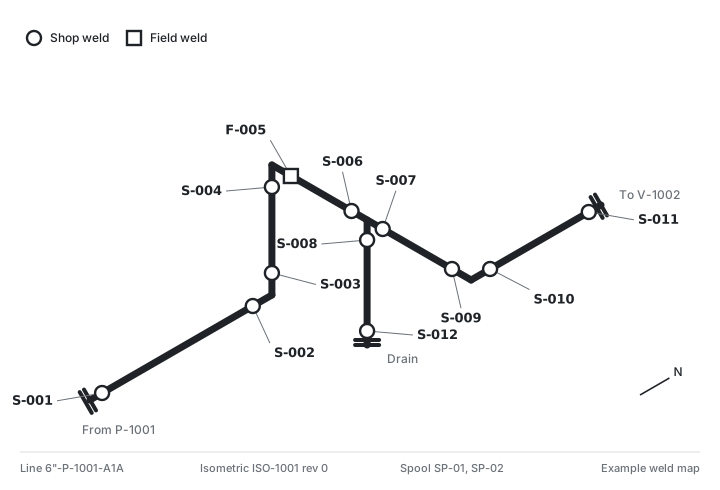
A weld map identifies every weld in a piece of work so it can be traced. For piping it is normally drawn on the fabrication or construction isometric; for structures and vessels it can be a separate sketch. Each weld symbol carries a number, and the same number is used in the weld log, the NDT requests and reports, and the repair records.
Weld maps are a requirement of most project specifications and quality systems, because they are how an inspector proves that the right welds were examined. For example, ASME B31.3 calls for random examination of at least 5 % of circumferential butt welds in normal fluid service, and the weld map shows which ones were picked. See NDT methods and the piping isometric symbols.
How to number welds
- Unique per drawing: weld numbers restart on each isometric, so the full reference is isometric plus weld number.
- Shop and field: welds made in the fabrication shop and welds made on site are usually distinguished, for example S-001 and F-005.
- Never reuse a number: a cut-out and re-welded joint keeps its number with a repair suffix, such as R1, so its history is not lost.
- Added welds: welds added later (a field fit-up weld, a design change) get the next free number, not an existing one.
The weld log template
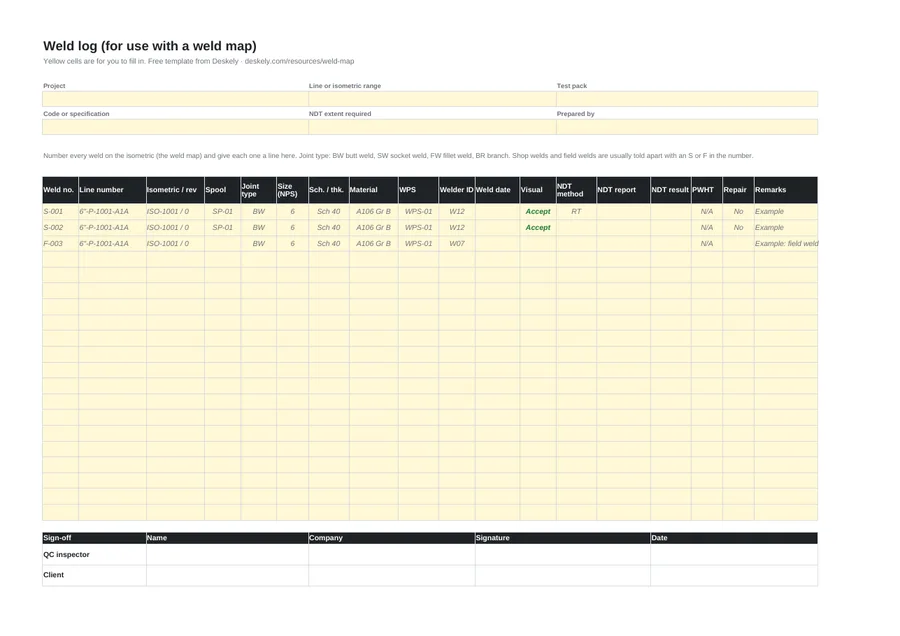
One line per weld: where it is (line, isometric, spool), what it is (joint type, size, schedule, material), how it was made (WPS, welder, date), and how it was checked (visual, NDT method, report and result, PWHT, repairs). Three example lines show the format.
From weld log to test pack
A line cannot be pressure tested until every weld in its test pack is welded, inspected and accepted. On a large project that means cross-checking thousands of weld log lines against hundreds of test packs.
Deskely holds inspection and NDT records against the tag and the test pack, checked as they are signed, so what is still blocking each pressure test is visible without the cross-check.
The Deskely products for this
Frequently asked questions
What is a weld map?
A drawing, usually the piping isometric, showing every weld with a unique number, so each weld can be traced to its welder, procedure and inspection records.
What is the difference between a weld map and a weld log?
The weld map shows where each weld is. The weld log is the table that records, for each weld number, how it was made and inspected.
How are welds numbered?
Uniquely on each isometric, usually with shop and field welds told apart (for example S-001, F-005), and repairs keeping the original number with a suffix.
What goes in a weld log?
Weld number, line and isometric, joint type, size, material, WPS, welder ID, date, visual and NDT results, PWHT and repairs.
- In production since 2014
- Thousands of daily users
- On MODEC FPSO projects since 2016