Completion certificate templates: mechanical completion, RFC, RFSU and handover (free Excel and PDF)
Deskely Completions team Singapore
On a capital project, completion is certified in steps: mechanical completion, ready for commissioning, ready for start-up and handover. Each certificate is signed per subsystem or system, and each one says exactly what has been proven so far.
This page gives you all four certificates as free templates in Excel and PDF, explains what each one certifies, and how they compare with the practical completion and substantial completion certificates used in building contracts.
- Mechanical completion: built and inspected to the drawings, A punch closed.
- Ready for commissioning: pre-commissioning done, safe to energise or fill.
- Ready for start-up: commissioned and tested, safe to start.
- Handover: care, custody and control pass to the owner.
The four certificates
| Certificate | Signed when | Typical attachments |
|---|---|---|
| Mechanical completion (MC) | The subsystem is built, installed and inspected; A ITRs signed; A punch closed. | A ITR register, punch list, pressure test certificates, redlines |
| Ready for commissioning (RFC) | Pre-commissioning is complete and B ITRs signed. | MC certificate, B ITR register, loop and calibration records |
| Ready for start-up (RFSU) | The system is commissioned, safety systems tested, PSSR complete. | RFC certificates, commissioning records, C&E tests, PSSR |
| Handover | The owner takes care, custody and control. | RFSU certificate, dossier, agreed punch list, spares, training |
Names vary by company: RFC is sometimes called commissioning complete or ready for energisation, and handover may be split into provisional and final acceptance. The sequence is the same. See mechanical completion and the pre-startup safety review for the detail behind MC and RFSU.
The templates
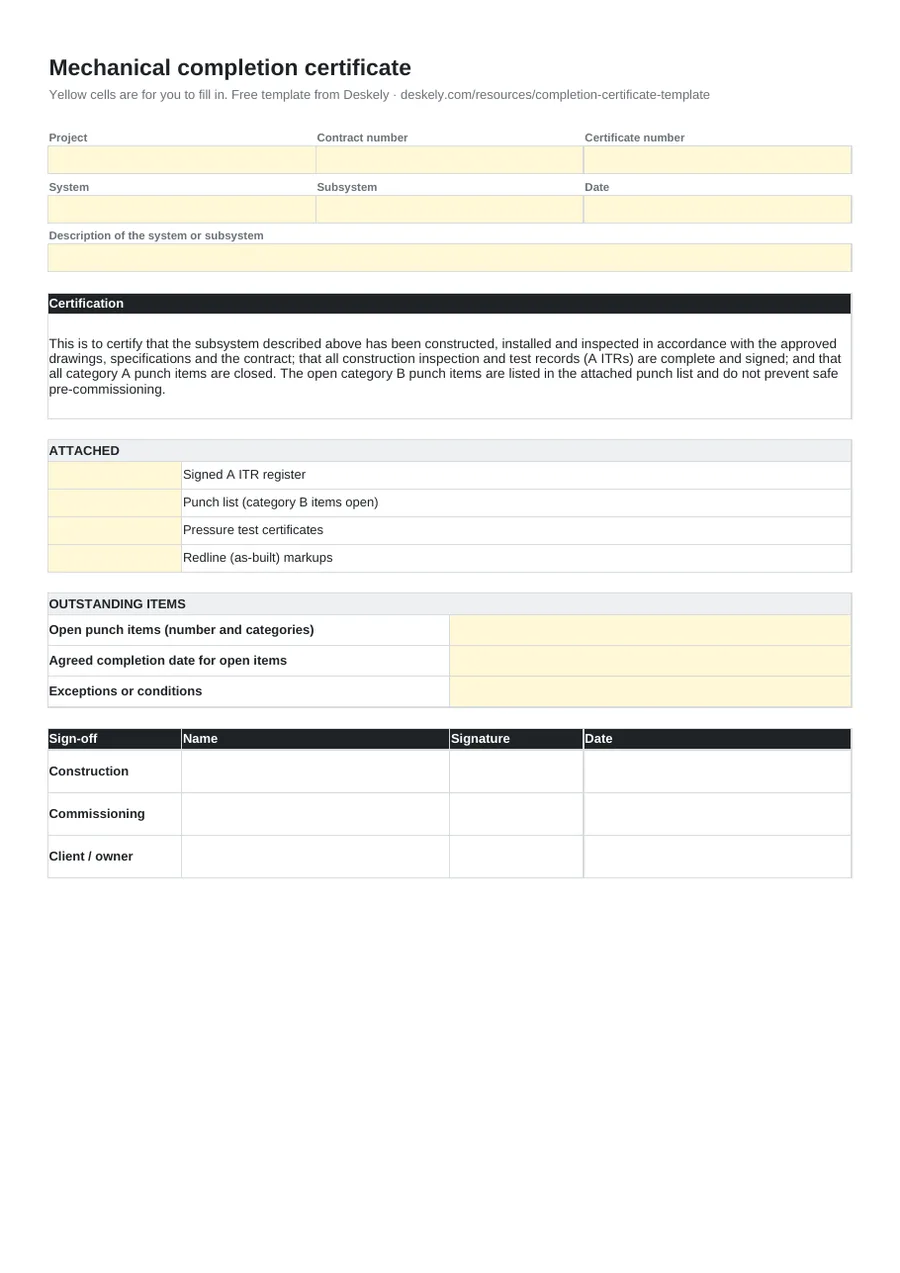
Each certificate has the project and subsystem fields, a certification statement, a checklist of attachments, the outstanding items with an agreed date, and signatures. Edit the statements to match your contract.
Practical completion and substantial completion
Building contracts use different words for a similar milestone. Under JCT contracts in the UK the architect or contract administrator issues a certificate of practical completion; in the US, AIA document G704 is the certificate of substantial completion; FIDIC contracts use a taking-over certificate. Each marks the point where the works are complete enough for the owner to use, subject to listed defects, and usually starts the defects period and releases part of the retention.
On industrial and offshore projects, the handover certificate plays that role, and the MC, RFC and RFSU certificates before it break the path into steps that can be signed one subsystem at a time.
Certificates from the records
A certificate is only as good as the records behind it. On a project with hundreds of subsystems, the risk is signing an MC with an unsigned ITR or an open A punch item buried somewhere.
In Deskely, each certificate is checked against the ITRs, punch items and test packs held against the subsystem's tags, so it can only be signed when the records say it is ready.
The Deskely products for this
Frequently asked questions
What is a mechanical completion certificate?
The certificate that a subsystem has been built, installed and inspected to the drawings and specifications, with construction ITRs signed and category A punch items closed.
What is RFSU?
Ready for start-up: the certificate that a system has been commissioned and tested and is safe to start up or receive hydrocarbons.
What is a certificate of practical completion?
In building contracts such as JCT, the certificate that the works are complete apart from minor defects, so the owner can take them over.
What is the difference between handover and practical completion?
Both mark the owner taking over the works. Handover is the term on industrial projects, often system by system; practical completion is the building-contract term, usually for the whole works or a section.
- In production since 2014
- Thousands of daily users
- On MODEC FPSO projects since 2016