Pre-startup safety review (PSSR): requirements, checklist and process
Deskely Completions team Singapore
A pre-startup safety review (PSSR) is the final check, before highly hazardous chemicals or process fluids are introduced, that a new or modified facility has been built as designed and that the procedures, training and hazard reviews needed to run it safely are in place. It is the last gate before start-up.
This guide covers what a PSSR is, what OSHA's process safety management standard requires, what a PSSR checklist covers, who takes part, and how the PSSR relates to mechanical completion and ready for start-up.
- A PSSR confirms a new or modified facility is safe to start before process chemicals are introduced.
- OSHA 29 CFR 1910.119(i) requires one for new facilities and significantly modified ones.
- It checks construction against design, procedures, PHA actions, MOC and training.
- Open PSSR items are tracked like punch items, and start-up waits for the ones that matter.
What is a pre-startup safety review?
A PSSR is a structured review, usually a walkdown plus a document check, carried out by a small multidisciplinary team before start-up. It answers one question: is everything in place to start this facility, or this change, safely?
It is one of the elements of process safety management, alongside process safety information, process hazard analysis (PHA), operating procedures, training, mechanical integrity and management of change.
What OSHA requires
Under OSHA's process safety management standard, 29 CFR 1910.119 paragraph (i), employers must perform a pre-startup safety review for new facilities, and for modified facilities when the modification is significant enough to require a change in the process safety information. The PSSR must confirm, before highly hazardous chemicals are introduced to a process, that:
- Construction and equipment are in accordance with design specifications.
- Safety, operating, maintenance and emergency procedures are in place and adequate.
- For new facilities, a process hazard analysis has been performed and its recommendations resolved or implemented before start-up.
- Modified facilities meet the management of change requirements.
- Training of each employee involved in operating the process has been completed.
Outside the US, the same practice is part of most operators' process safety management systems and of regimes such as Seveso III in the EU and COMAH in the UK, even where the term PSSR is not used.
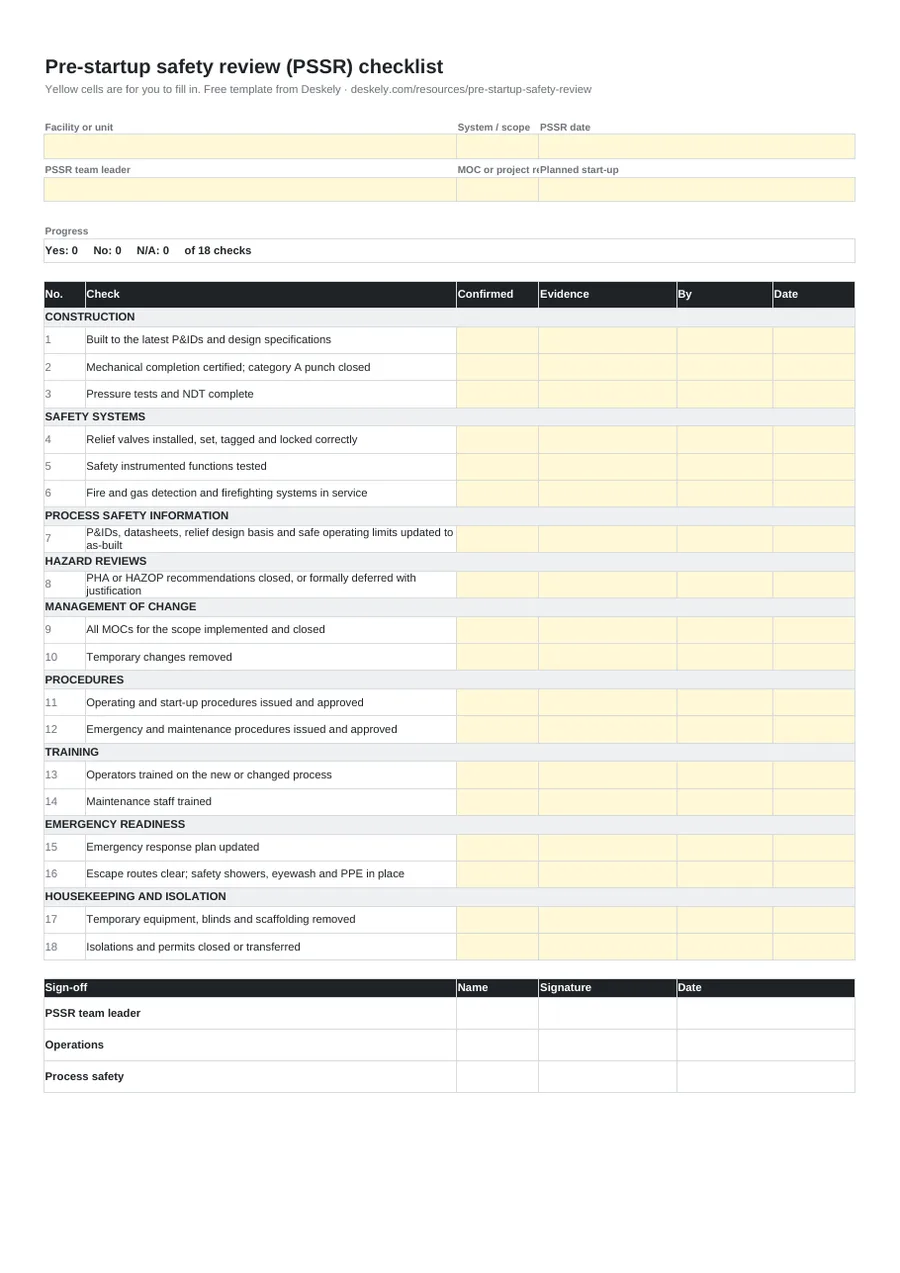
PSSR checklist
| Area | Typical checks |
|---|---|
| Construction | Built to the latest P&IDs and design; mechanical completion certified; A punch closed; pressure tests and NDT complete |
| Safety systems | Relief valves installed, set and locked correctly; safety instrumented functions tested; fire and gas detection and firefighting in service |
| Process safety information | P&IDs, datasheets, relief design basis and safe operating limits updated to as-built |
| Hazard reviews | PHA or HAZOP recommendations closed, or formally deferred with justification |
| Management of change | All MOCs for the scope implemented and closed, temporary changes removed |
| Procedures | Operating, start-up, emergency and maintenance procedures issued and approved |
| Training | Operators and maintenance staff trained on the new or changed process |
| Emergency readiness | Emergency response plan updated, escape routes clear, safety equipment in place |
| Housekeeping and isolation | Temporary equipment, blinds and scaffolding removed; isolations and permits closed |
Projects usually add their own items. Each finding is categorised: items that must be closed before start-up, and items that can be closed after start-up with an owner and a date.
Who takes part
A typical PSSR team is led by someone independent of the construction work, with operations, process engineering, maintenance and inspection, safety, and the relevant engineering disciplines. On larger projects, PSSRs are done system by system as each is ready for start-up, rather than once for the whole facility.
PSSR, mechanical completion and RFSU
The PSSR sits at the end of commissioning, just before the ready for start-up (RFSU) certificate. Much of its evidence comes from completions records that already exist: mechanical completion certificates, signed ITRs, closed punch items, pressure test packs and commissioning test results. If those records are scattered, the PSSR becomes a document hunt; if they are held against each tag and system, it becomes a review.
See the commissioning checklist for where the PSSR fits in the sequence from MC to handover.
The Deskely products for this
Frequently asked questions
What is a pre-startup safety review?
A review before start-up that confirms a new or modified facility is built to design and that the procedures, hazard reviews, management of change and training needed to run it safely are complete.
When is a PSSR required?
Under OSHA 29 CFR 1910.119(i), for new facilities, and for modified facilities when the modification is significant enough to require a change in the process safety information.
What does a PSSR check?
That construction and equipment match the design, procedures are in place, PHA recommendations are resolved for new facilities, changes meet MOC requirements, and the people operating the process are trained.
Who performs a PSSR?
A multidisciplinary team, typically led by someone independent of construction, with operations, process engineering, maintenance, inspection and safety.
Is a PSSR the same as mechanical completion?
No. Mechanical completion certifies the facility is built and inspected. The PSSR comes later, just before start-up, and also covers procedures, training, hazard reviews and changes.
- In production since 2014
- Thousands of daily users
- On MODEC FPSO projects since 2016