Factory acceptance test (FAT) checklist: free template with FAT punch list (Excel and PDF)
Deskely Completions team Singapore
A factory acceptance test (FAT) proves that a piece of equipment or a package works as specified before it leaves the vendor's works. A FAT checklist makes sure nothing is missed on the day: documents, dimensions, electrical checks, functions, performance and what happens next.
This page gives you a free FAT checklist in Excel and PDF with 28 checks and a FAT punch list, and explains how to prepare for a FAT and how the same sheet carries over to the site acceptance test (SAT).
- A FAT follows an approved procedure, agreed with the vendor before the test.
- Check the documents first: drawings, certificates and calibration of the test equipment.
- Anything not accepted becomes a FAT punch item, marked to close before or after shipment.
- The FAT punch list must follow the equipment to site.
What a FAT checklist covers
| Group | What it checks |
|---|---|
| Documentation | Approved procedure, drawings and datasheets, material and pressure test certificates, calibration of test equipment, Ex certificates, software versions. |
| Visual and dimensional | Dimensions and nozzle orientations, tag plates, workmanship, cable glands and terminations, earthing, lifting points. |
| Electrical | Insulation resistance, continuity, earth bonding, supplies, wiring against drawings. |
| Functional | Operating modes, alarms and trips, interlocks against the cause and effect, control loops, redundancy and failure tests. |
| Performance | Run test at rated conditions, noise and vibration, capacity against the datasheet. |
| Close-out | Punch list agreed, preservation and packing, FAT certificate or release note. |
The template
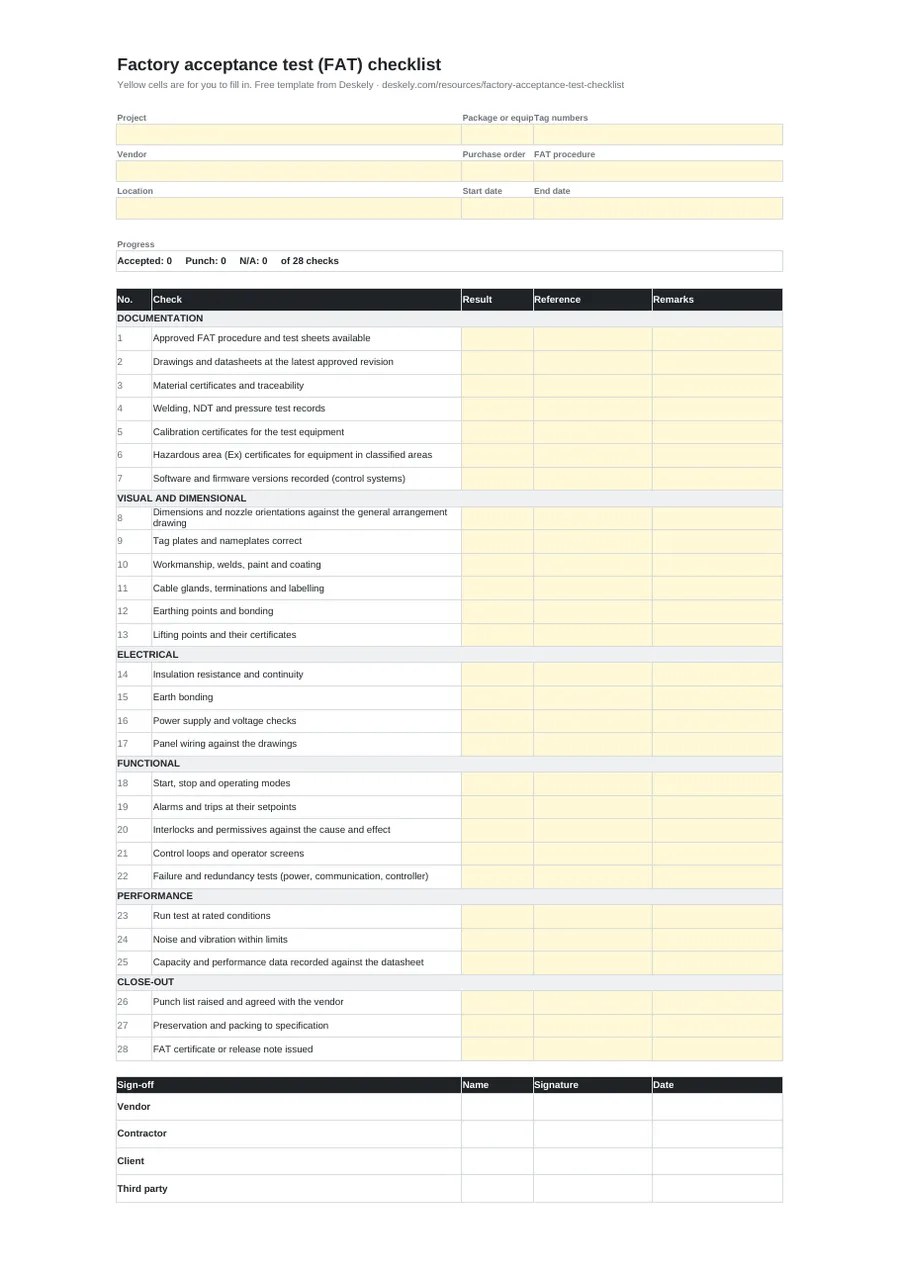
Set each check to Accepted, Punch or N/A and the counts at the top update. Items marked Punch go on the FAT punch list sheet, with a category: A to close before shipment, B to close at site.
Preparing for a FAT
- 01Agree the procedure
Get the vendor's FAT procedure and test sheets approved well before the test date.
- 02Check readiness
Ask the vendor to confirm the equipment is complete, pre-tested and documented before you travel.
- 03Bring the right people
Mechanical, electrical, instrument and operations, and the client and third party where required.
- 04Run the checks
Work through the checklist and record results and references as you go.
- 05Agree the punch list
Categorise every open item and agree who closes it and when, then sign the FAT certificate or release note.
Using the checklist for SAT
A site acceptance test repeats the key checks after installation, with the equipment connected to the real utilities and systems. Copy the sheet, keep the functional and performance groups, add the interfaces to the rest of the plant, and close out the FAT punch items that were left for site. See FAT vs SAT for the differences. For process automation systems, IEC 62381 describes FAT, factory integration tests and SAT in detail.
In Deskely, punch items raised at FAT are held against the tag, so they are still open and visible when the equipment reaches site.
The Deskely products for this
Frequently asked questions
What is a FAT checklist?
A list of the documents, inspections and tests to carry out at a factory acceptance test, with a result and reference for each, so the equipment can be released for shipment.
What is the difference between FAT and SAT?
FAT is done at the vendor's works before shipment; SAT is done on site after installation, with the equipment connected to the real systems.
Who attends a FAT?
The vendor, the buyer's engineers and inspectors, and often the end client and a third party inspector.
What happens to items that fail at FAT?
They go on the FAT punch list, categorised as must close before shipment or can close at site, with an owner and a date.
- In production since 2014
- Thousands of daily users
- On MODEC FPSO projects since 2016