Method statement template: how to write a method statement (RAMS)
Deskely Completions team Singapore
A method statement sets out how a specific task will be done safely, step by step: who does it, with what, in what order, under which permits, and how each hazard is controlled. Combined with the risk assessment it is often called RAMS, and in Australia a safe work method statement (SWMS) is required for high risk construction work.
This guide covers what a method statement is for, what goes in one, how it differs from a risk assessment, a procedure and an ITP, and how to write one that people on site actually read. A free method statement template in Word and PDF is included.
- A method statement says how one task is done safely: sequence, people, equipment, permits and controls.
- RAMS is the risk assessment and method statement together; SWMS is the Australian equivalent for high risk work.
- Write it for the people doing the job: specific steps, not generic paragraphs.
- Brief it to the crew before work starts and keep the signed briefing record.
What is a method statement?
A method statement (also safe system of work, work method statement or job method statement) is a document that describes how a particular piece of work will be carried out. It turns the findings of the risk assessment into a sequence of steps with the controls built in, so the crew, the supervisor and the client all agree how the job will be done before it starts.
Main contractors and clients usually ask subcontractors for method statements before work starts on site, particularly for high-risk activities: lifting, work at height, hot work, confined space entry, excavation, energisation, pressure testing and work on live systems.
RAMS, SWMS and method statements
| Term | Meaning | Where |
|---|---|---|
| Method statement | How the task is done safely, step by step | Everywhere |
| Risk assessment | The hazards, who could be harmed, and the controls | Everywhere; legally required in the UK and EU |
| RAMS | Risk assessment and method statement, as one package | UK and many international projects |
| SWMS | Safe work method statement, required for high risk construction work | Australia (WHS Regulations) |
| JSA / JHA / TRA | Job safety analysis, job hazard analysis, task risk assessment: a shorter, task-level risk review | Oil and gas, US and international sites |
In the UK, risk assessments are a legal requirement under the Management of Health and Safety at Work Regulations 1999; method statements are not named in law but are the normal way to show how the risks will be controlled, and CDM 2015 expects work to be planned and managed. In Australia, a SWMS must be prepared before high risk construction work begins.
What goes in a method statement
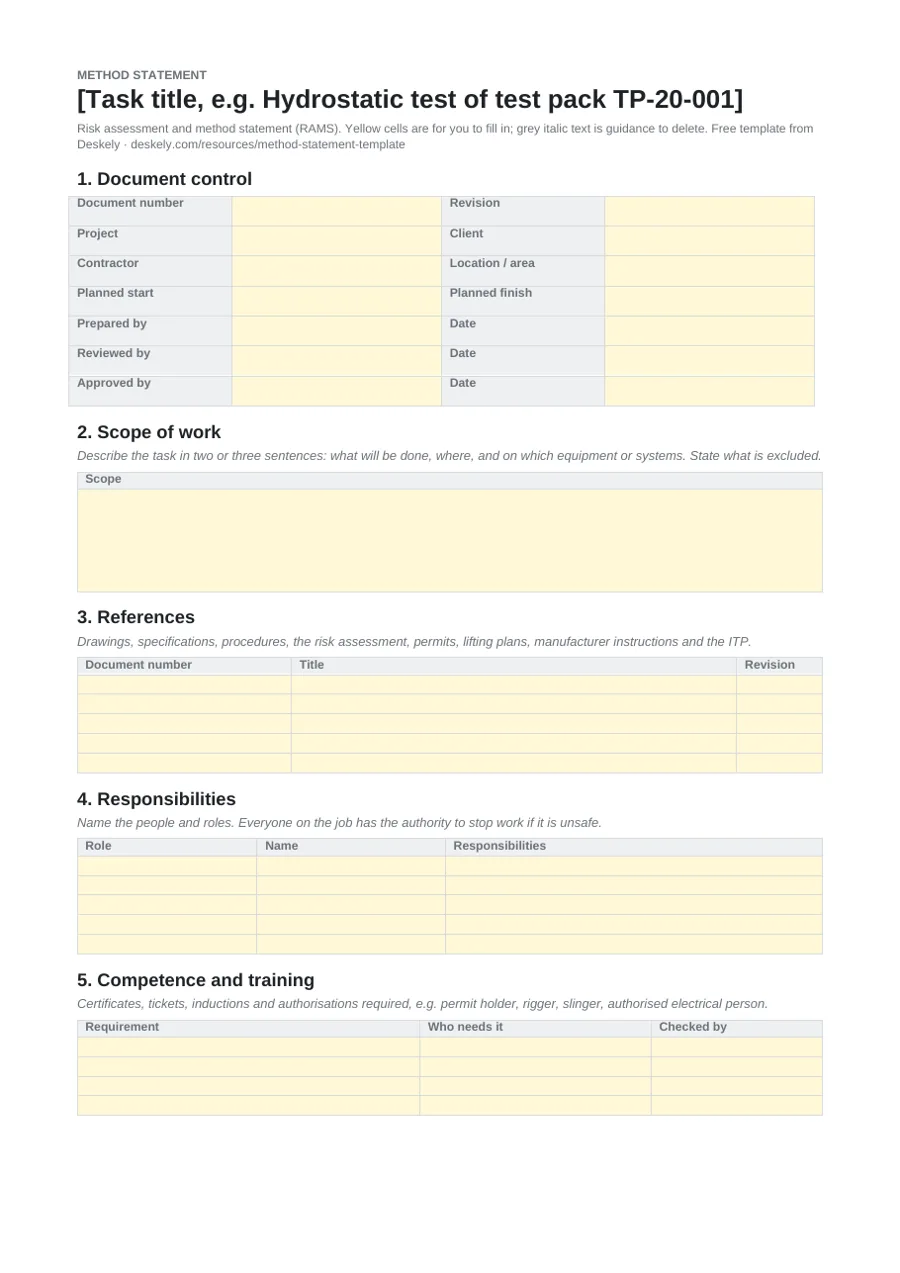
- Document control: title, number, revision, project, contractor, prepared, reviewed and approved by, dates.
- Scope of work: what the task is, where, and what is excluded.
- References: drawings, specifications, procedures, the risk assessment, permits and manufacturer instructions.
- Responsibilities: who supervises, who does what, and who has authority to stop the job.
- Competence and training: certificates, tickets and inductions the crew needs.
- Plant, tools and equipment: with inspection or certification requirements.
- Materials and substances: including any COSHH or SDS assessments.
- Sequence of work: numbered steps, from preparation and isolation to completion and handback.
- Hazards and controls: the risk assessment, step by step or as a table.
- Permits and isolations: permit to work, hot work, confined space, electrical isolation, lifting plan.
- PPE: task-specific, beyond the site minimum.
- Environment: waste, spills, noise, dust.
- Emergency arrangements: first aid, rescue plan, emergency contacts, muster point.
- Inspection and testing: hold points, the ITP and records to complete.
- Briefing record: the crew sign to say they have been briefed and understand it.
How to write a method statement
- 01Start with the risk assessment
Walk the job, list the hazards for each step and decide the controls. The method statement is how those controls get done.
- 02Write the sequence as the job is done
Short numbered steps in the order the crew will work, each with the person responsible.
- 03Be specific to the site and the task
Name the equipment, the location, the isolation points and the permit types. Generic text copied from the last job is the commonest failure.
- 04Put the controls in the steps
If a step needs an exclusion zone or a gas test, say so in that step, not only in an appendix.
- 05Include hold points
Where the work stops for an inspection, a test or a permit check, mark it.
- 06Review it with the people doing the job
The crew and the supervisor know where the plan will not work.
- 07Get it approved and brief it
Have it reviewed and approved, brief it at the workface, and record who was briefed.
- 08Revise it when things change
A change in method, equipment or conditions means a revision and a re-brief.
Example: method statement for a hydrostatic pressure test
A short outline of the sequence section for a hydrostatic test of a piping test pack:
- 01Confirm release
The test pack is released: walkdown complete, NDT accepted, A punch items closed, test limits and spades marked up.
- 02Permit and barriers
Obtain the permit to work; set up barriers and signs around the test area and at every end of the test boundary.
- 03Isolate and blind
Install spades, blinds and test caps to the test pack; remove or isolate PSVs, instruments and in-line items not rated for the test.
- 04Fit test equipment
Fit calibrated test gauges and a recorder, and a test relief valve set to protect the system.
- 05Fill and vent
Fill with water, venting at the high points until all air is removed.
- 06Pressurise in stages
Raise the pressure in stages to the test pressure, checking for leaks at each stage. Hold point: no one in the exclusion zone while pressurising.
- 07Hold and inspect
Hold for the required time and inspect every joint. Hold point: witnessed by QC and the client.
- 08Depressurise and drain
Depressurise in a controlled way, drain to the agreed point and dry if required.
- 09Reinstate
Remove the test equipment, reinstate every spade, gasket and item removed, and sign the reinstatement record.
Each step would carry its hazards and controls (stored energy, manual handling, water disposal) and the person responsible.
Method statement vs procedure vs ITP
| Document | Answers | Example |
|---|---|---|
| Method statement | How will this task be done safely here? | Lifting a pump module onto the deck |
| Work procedure | How is this kind of work done, in general? | Company procedure for flange bolt-up |
| Commissioning procedure | How is this system tested and started up? | Seawater lift pump system commissioning |
| ITP (inspection and test plan) | Which inspections and tests, with which hold and witness points? | ITP for piping fabrication |
| ITR (inspection and test record) | What was checked, and was it acceptable? | Signed record for one tag; see the ITR guide |
Common mistakes
- Generic text that could apply to any job on any site.
- Long paragraphs instead of numbered steps, so nobody reads it.
- Controls in the risk assessment that never appear in the steps.
- No hold points, so the inspector arrives after the work is buried.
- Not updated when the method changes on the day.
- Signed off by the office but never briefed to the crew.
From method statements to commissioning procedures
On commissioning, the same discipline applies to every system test: the prerequisites, the isolations, the steps, the acceptance criteria and the sign-off. Writing those procedures for hundreds of systems from the P&IDs is one of the biggest documentation jobs on a project, and the procedures drift as the drawings change.
Deskely Sequence drafts commissioning procedures from the P&IDs and the system register in your own template, with every tag in every step linked to the register, and flags steps that depend on a drawing that has changed.
The Deskely products for this
Frequently asked questions
What is a method statement?
A document that describes, step by step, how a specific task will be carried out safely: the sequence, the people, the equipment, the permits and the controls for each hazard.
What is the difference between a risk assessment and a method statement?
A risk assessment identifies the hazards and decides the controls. A method statement sets out how the work will be done with those controls in place. Together they are often called RAMS.
What does RAMS stand for?
Risk assessment and method statement.
What is a SWMS?
A safe work method statement, required in Australia before high risk construction work begins. It lists the high risk activities, the hazards, the controls and how they will be put in place and monitored.
Is a method statement a legal requirement?
In the UK, risk assessments are a legal requirement and method statements are the usual way to show how the risks are controlled, though the law does not name them. In Australia a SWMS is required for high risk construction work.
What should a method statement include?
Scope, references, responsibilities, competence, equipment, the sequence of work, hazards and controls, permits, PPE, emergency arrangements, inspection hold points and a briefing record.
- In production since 2014
- Thousands of daily users
- On MODEC FPSO projects since 2016