Motor test report: free template with solo run record (Excel and PDF)
Deskely Completions team Singapore
Before a motor drives its pump, fan or compressor, it is tested on its own: insulation and winding checks first, then a solo run with the coupling disconnected to confirm direction of rotation, current, vibration and bearing temperatures.
This page gives you a free motor test report in Excel and PDF covering both, with the polarisation index and winding imbalance worked out for you.
- Test the insulation before the first start, and after long storage.
- Run the motor uncoupled first: a wrong direction can damage the driven machine.
- Record current, vibration and bearing temperature over the run, not once.
- The solo run is a B ITR; the coupled run belongs to commissioning.
What the motor test covers
- Pre-checks: nameplate, mounting and earthing, terminal box and glands, heater, lubrication, free rotation, coupling disconnected.
- Insulation resistance: windings to earth at the test voltage, with the polarisation index. IEEE 43 recommends a minimum PI of 2.0 for class B, F and H insulation. See the megger test report.
- Winding resistance: U-V, V-W and W-U should be close; a large imbalance points to a loose connection or a winding fault.
- Solo run: direction of rotation, starting time, no-load current on each phase, vibration and bearing temperatures over time.
The template
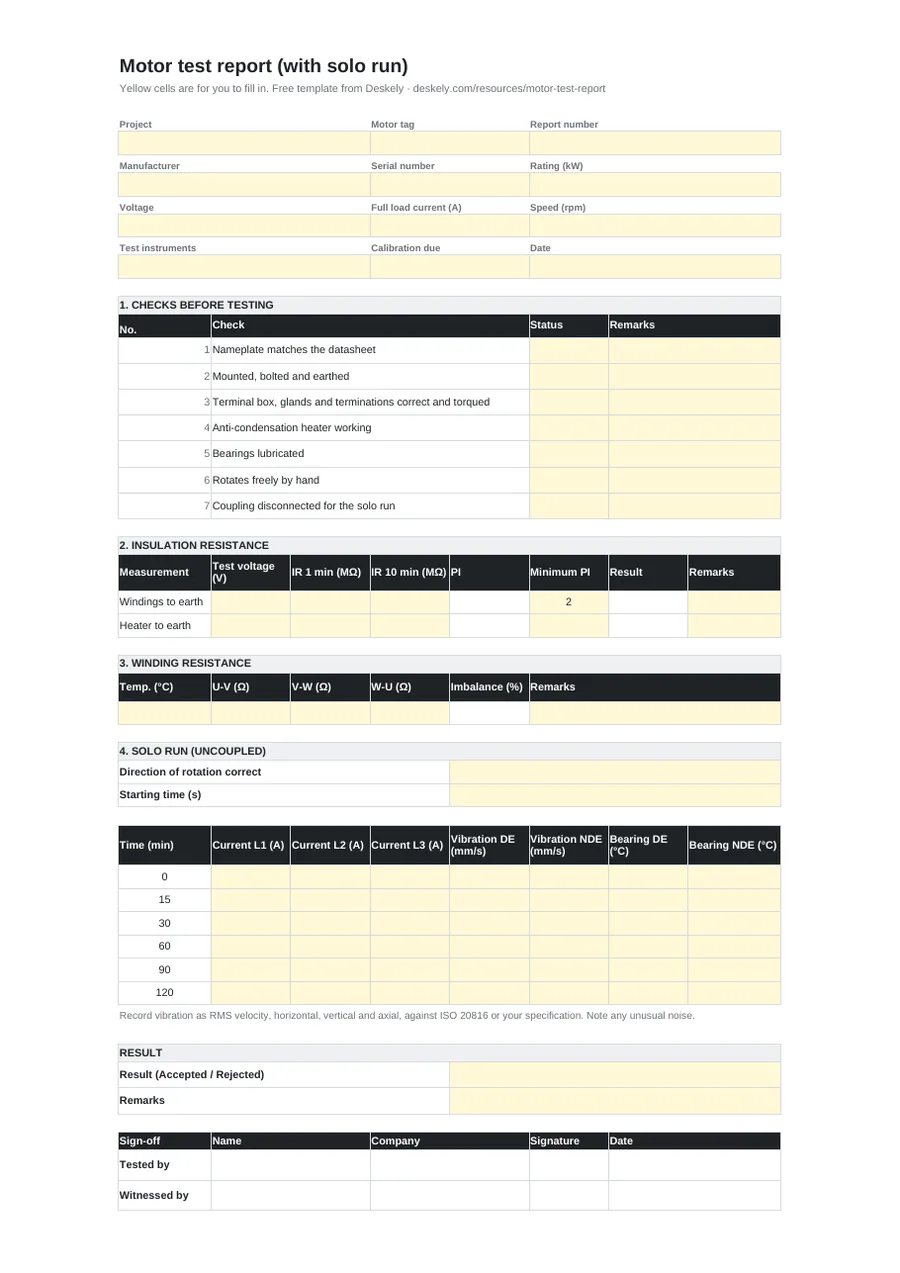
The solo run table records readings at the start and then at intervals up to two hours. Bearing temperatures should level off; a temperature that keeps climbing, or vibration that rises, needs investigating before the motor is coupled.
Vibration and temperature
Record vibration as RMS velocity in mm/s at both bearings, horizontal, vertical and axial. ISO 20816 gives evaluation zones by machine size and support; many projects set their own acceptance values in the specification or take them from the motor vendor.
Motor tests sit in pre-commissioning, with the rest of the pre-commissioning checklist. In Deskely, the readings are recorded against the motor's tag and checked against the expected values as they are entered.
The Deskely products for this
Frequently asked questions
What is a motor solo run?
Running a motor uncoupled from its driven machine to check direction of rotation, no-load current, vibration and bearing temperatures before coupling.
How long is a motor solo run?
Commonly one to two hours, or until bearing temperatures stabilise. Your specification or the vendor may set a duration.
What insulation resistance should a motor have?
The minimum depends on the voltage rating and your specification; IEEE 43 gives minimums and recommends a PI of at least 2.0 for class B, F and H insulation.
What does winding resistance imbalance show?
A difference between phases larger than expected points to a loose or poor connection, or a winding fault.
- In production since 2014
- Thousands of daily users
- On MODEC FPSO projects since 2016