Solar PV string test report: free IEC 62446-1 test sheet (Excel and PDF)
Deskely Completions team Singapore
A solar PV string test report records the category 1 tests of IEC 62446-1 on each string of a PV array: open circuit voltage against the expected value, string current, polarity and insulation resistance of the positive and negative conductors to earth, together with the irradiance, temperature and instruments used.
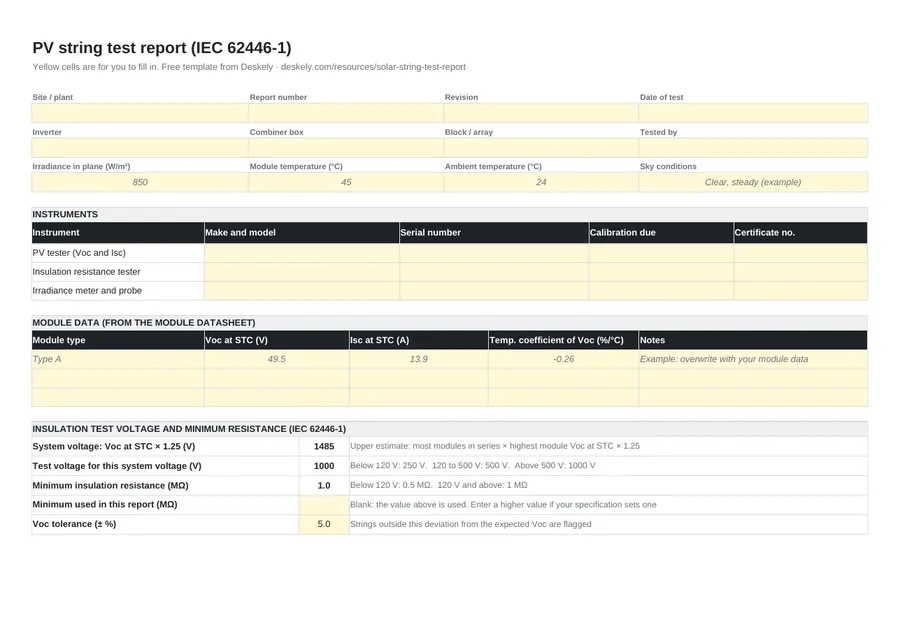
This page gives you a free string test report in Excel and PDF: site, inverter and combiner box header, instruments with calibration dates, module data, an automatic test voltage and minimum insulation resistance from the system voltage, and a string table that works out the expected Voc and Isc and flags deviations, low insulation and reversed polarity.
- Expected Voc = modules in series × Voc at STC, corrected for module temperature.
- Strings of the same design should agree closely; a common acceptance band is ±5 % of expected Voc.
- IEC 62446-1 insulation test: 1 MΩ minimum at 500 V or 1000 V test voltage for systems above 120 V.
- Record irradiance and temperature with every test, or the readings cannot be compared.
The category 1 tests on a string
IEC 62446-1 (Photovoltaic systems, requirements for testing, documentation and maintenance, part 1: grid connected systems) sets the minimum tests for every system as category 1. Those made string by string are:
| Test | What it confirms | Typical fault found |
|---|---|---|
| Polarity | Positive and negative connected the right way, before isolators are closed | A reversed string, which can damage the inverter |
| Open circuit voltage (Voc) | The right number of modules, all connected, in the string | A missing, bypassed or reversed module, a wrong string length |
| String current (Isc or operating) | Current in line with irradiance and with the other strings | Shading, damaged modules, poor connections |
| Insulation resistance | No leakage path from the DC conductors to earth | Damaged cable insulation, water in a connector |
Category 1 also covers continuity of protective earthing and bonding, the combiner box test and functional tests; the template has a short check list for those per combiner box. Category 2 adds I-V curve tracing and infrared thermography. See the solar commissioning guide for the full sequence.
Expected Voc and the 5 % check
Expected Voc = modules in series × Voc at STC × (1 + temperature coefficient of Voc / 100 × (module temperature − 25 °C)). Voc falls as the module warms, so a cold morning reads high and a hot afternoon low.
| Example | Value |
|---|---|
| Modules in series | 24 |
| Voc at STC (datasheet) | 49.5 V |
| Temperature coefficient of Voc | −0.26 %/°C |
| Module temperature | 45 °C |
| Expected string Voc | 24 × 49.5 × (1 − 0.0026 × 20) = 1126 V |
| Measured 1131 V | Deviation +0.4 %: pass |
A common acceptance band is ±5 % of the expected value. Note that one missing or bypassed module in a 24-module string lowers Voc by about 4 %, inside that band, so also compare each string with its neighbours measured at the same time: strings of the same design should read within a few volts of each other.
Insulation resistance: test voltage and minimum
IEC 62446-1 sets the test voltage and the minimum insulation resistance by the system voltage, taken as Voc at STC × 1.25:
| System voltage (Voc STC × 1.25) | Test voltage | Minimum insulation resistance |
|---|---|---|
| Below 120 V | 250 V | 0.5 MΩ |
| 120 V to 500 V | 500 V | 1 MΩ |
| Above 500 V | 1000 V | 1 MΩ |
The template works the system voltage out from the longest string and the module data, and picks the test voltage and minimum from this table. If your specification asks for a higher minimum, enter it and the results use that instead. Test with the array isolated from the inverter, test positive to earth and negative to earth, and never break a DC connector under load. Readings of a few MΩ on a large array are worth investigating even when they pass. See the insulation resistance test guide.
What is in the template
| Sheet | Fields |
|---|---|
| String test (header) | Site, report number, revision, date, inverter, combiner box, block, tested by, irradiance in plane (W/m²), module temperature, ambient temperature, sky conditions |
| String test (instruments and modules) | PV tester, insulation tester and irradiance meter with make, serial, calibration due and certificate; up to three module types with Voc and Isc at STC and the Voc temperature coefficient |
| String test (limits) | System voltage, test voltage and minimum insulation resistance worked out to IEC 62446-1, an optional project minimum, and the Voc tolerance (5 % by default); category 1 checks for the combiner box |
| String test (strings) | String ID, module type, modules in series, expected Voc, measured Voc, Voc deviation, expected Isc, measured Isc, Isc deviation, polarity, insulation + and − to earth, insulation result, overall result, remarks; two worked example rows and live counts of passes, fails, Voc outside tolerance, low insulation and reversed polarity |
Where string tests fit
String tests come after the visual inspection of modules, mounting, cabling and connectors, and before the inverters are commissioned. On a utility-scale plant they run block by block, then the collection system and plant substation follow, much like any substation commissioning. The megger test report covers insulation tests on the AC side.
String tests in Deskely
Deskely records string, combiner and inverter tests on a tablet against each tag and checks readings against expected values as they are entered.
The Deskely products for this
Frequently asked questions
How do you calculate the expected Voc of a solar string?
Multiply the number of modules in series by the module Voc at STC, then correct for temperature: multiply by 1 + the Voc temperature coefficient (in %/°C, divided by 100) × (module temperature − 25 °C).
What is an acceptable Voc deviation for a PV string?
A common acceptance band is ±5 % of the expected value. Compare strings of the same design with each other as well, since one missing module can sit inside 5 %.
What is the minimum insulation resistance for a PV array?
Under IEC 62446-1, 1 MΩ for systems above 120 V (tested at 500 V up to 500 V system voltage, 1000 V above), and 0.5 MΩ at 250 V for systems below 120 V.
What test voltage is used for PV insulation resistance?
It depends on the system voltage, Voc at STC × 1.25: 250 V below 120 V, 500 V from 120 to 500 V, and 1000 V above 500 V.
Why record irradiance during string tests?
String current is proportional to irradiance, so a current reading means little without it. Test under steady irradiance and record it with every set of readings.
- In production since 2014
- Thousands of daily users
- On MODEC FPSO projects since 2016