Ex inspection checklist: free IEC 60079-17 inspection record and defect list (Excel and PDF)
Deskely Completions team Singapore
An Ex inspection checklist is the record of an inspection of electrical equipment installed in a hazardous area, following IEC 60079-17: it confirms that the equipment still suits its zone, gas group and temperature class, and that its protection has not been compromised by damage, missing parts, poor installation or the environment.
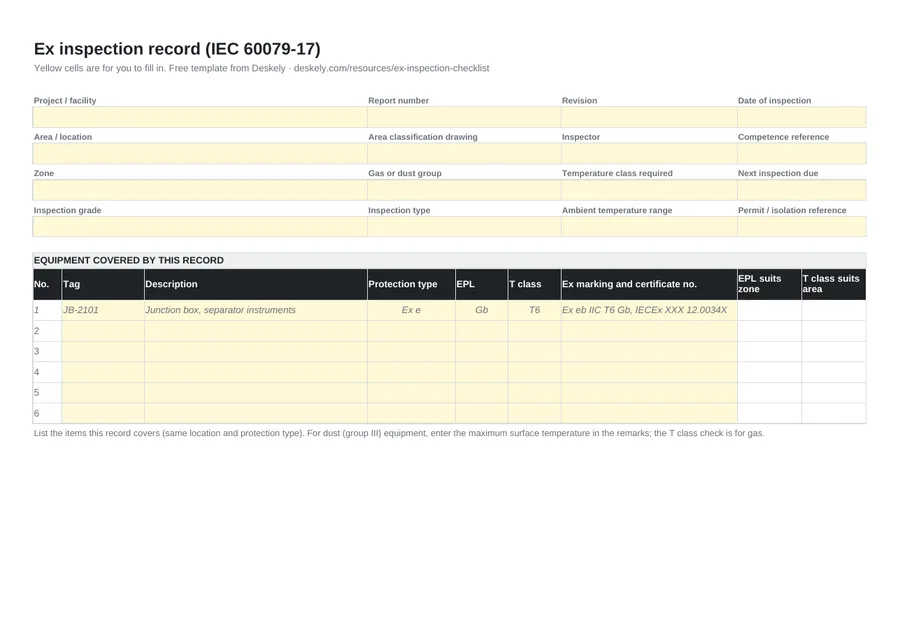
This page gives you a free Ex inspection record in Excel and PDF: the area and equipment details, an automatic check that each item's EPL and T class suit the location, 37 checks marked by the grades they apply to, results with defect categories and re-inspection dates, and a defect list.
- IEC 60079-17 has three grades of inspection: visual, close and detailed.
- Initial inspections, before equipment goes into service, are detailed.
- Each item must suit the zone (EPL), the gas group and the temperature class of its location.
- Every defect gets a category, an owner and a date, and is tracked against the tag.
Grades and types of Ex inspection
IEC 60079-17 (Explosive atmospheres, part 17: electrical installations inspection and maintenance) sets the grade of an inspection by how deep it goes, and the type by when and how much is inspected.
| Grade | What it finds | Example |
|---|---|---|
| Visual (V) | Defects that can be seen without access equipment or tools | A missing cover bolt, a cracked window |
| Close (C) | Visual, plus defects found only with access equipment and tools, such as steps; enclosures are not normally opened | A loose cable gland or bolt |
| Detailed (D) | Close, plus defects found only by opening the enclosure or using test equipment, with the equipment isolated | A loose termination, a damaged flamepath |
| Type | When |
|---|---|
| Initial | Before the equipment is put into service; a detailed inspection of every item |
| Periodic | Routinely, at an interval set from the equipment, its environment and past results |
| Sample | A proportion of the equipment, used to set or confirm the periodic interval |
The standard sets three years as the longest periodic interval without expert advice, and allows continuous supervision by skilled personnel as an alternative to fixed periodic inspection. Check the edition your procedure cites, since tables and wording change between editions.
What the checks cover
The checks follow the grouping of IEC 60079-17 Table 1, which covers flameproof (Ex d), increased safety (Ex e), type n and dust protection by enclosure (Ex t), with extra tables for intrinsic safety (Ex i) and pressurisation (Ex p). In each group, some checks are made at every grade and some only at a detailed inspection.
| Group | Typical checks |
|---|---|
| General | EPL and protection type suit the zone; equipment group and temperature class suit the area; equipment identified; certificate and its specific conditions of use met |
| Equipment | Enclosure and glass undamaged; no unauthorised modification; bolts, glands and blanking elements complete and tight; flamepath condition; gaskets; terminations; lamps; motor fan clearance |
| Installation | Cable type and condition; seals, stopping boxes and conduit; earthing and bonding; earth fault loop impedance; protective device settings; obstructions near flameproof joints |
| Environment | Protection against corrosion, weather and vibration; dust and dirt build-up; insulation clean and dry |
The wording in the template is our own. It is a working checklist, not a copy of the standard, so check it against the edition and the company procedure you work to.
Matching the equipment to the area
| Zone | Equipment protection level allowed |
|---|---|
| Zone 0 | Ga |
| Zone 1 | Ga or Gb |
| Zone 2 | Ga, Gb or Gc |
| Zone 20 | Da |
| Zone 21 | Da or Db |
| Zone 22 | Da, Db or Dc |
The temperature class must be at least as high as the area needs: T4 equipment (135 °C) can go where T3 is required, not the other way round. The template works out both for every item listed: pick the zone and the required T class at the top, enter each item's EPL and T class, and the EPL suits zone and T class suits area columns answer Yes or No. See hazardous area classification for zones, gas groups and Ex markings.
What is in the template
| Sheet | Fields |
|---|---|
| Ex inspection (header) | Project, report number, revision, date, area, area classification drawing, inspector, competence reference, zone (0, 1, 2, 20, 21, 22), gas or dust group, required T class, next inspection due, inspection grade (Visual, Close, Detailed), type (Initial, Periodic, Sample), ambient range, permit reference |
| Ex inspection (equipment) | Tag, description, protection type (d, e, i, p, n/ec, t, m, o, q), EPL, T class, Ex marking and certificate number, and calculated EPL suits zone and T class suits area |
| Ex inspection (checks) | 37 checks in five groups with D, C and V columns marking the grades each applies to, an in this grade column driven by the grade chosen, result (Pass, Fail, N/A), defect found, defect category, re-inspection date; live counts and an overall result |
| Defect list | Defect number, report, tag, check number, defect, category (1 Immediate, 2 Urgent, 3 Planned), action, owner, re-inspection date, status and closed date; counts of open, closed, category 1 open and overdue |
Where Ex inspection fits in completions
On a new installation the initial detailed inspection is part of mechanical completion for the electrical and instrument scope: equipment installed to IEC 60079-14, then inspected before the subsystem is energised. Failed checks become punch items, and those that make the equipment unsafe stop energisation. See the electrical inspection checklist, the mechanical completion checklist, the ITR guide and the energisation certificate.
Ex inspections in Deskely
Deskely Verify runs Ex inspections on your own templates against each tag and checks the record as it is signed, so open Ex findings show on the subsystem and the certificates they hold back.
The Deskely products for this
Frequently asked questions
What is an Ex inspection?
An inspection of electrical equipment in a hazardous area, following IEC 60079-17, to confirm it still suits its location and that its explosion protection is intact.
What are the three grades of Ex inspection?
Visual, close and detailed. A visual inspection finds what can be seen without tools, a close inspection adds access equipment and tools, and a detailed inspection opens the enclosure or uses test equipment.
How often should Ex equipment be inspected?
Initially before it is put into service, then periodically. IEC 60079-17 sets three years as the longest interval without expert advice; the actual interval depends on the equipment, its environment and past results.
What is the difference between an initial and a periodic Ex inspection?
An initial inspection is a detailed inspection of every item before it goes into service. Periodic inspections follow at set intervals and may be visual or close, with a detailed inspection of a sample.
Who can carry out Ex inspections?
Skilled persons with knowledge of the protection types, installation practice and the rules for hazardous areas, as IEC 60079-17 requires. Many employers use the IECEx certificate of personnel competence as evidence.
- In production since 2014
- Thousands of daily users
- On MODEC FPSO projects since 2016