Insulation inspection checklist: free thermal insulation and cladding checklist (Excel and PDF)
Deskely Completions team Singapore
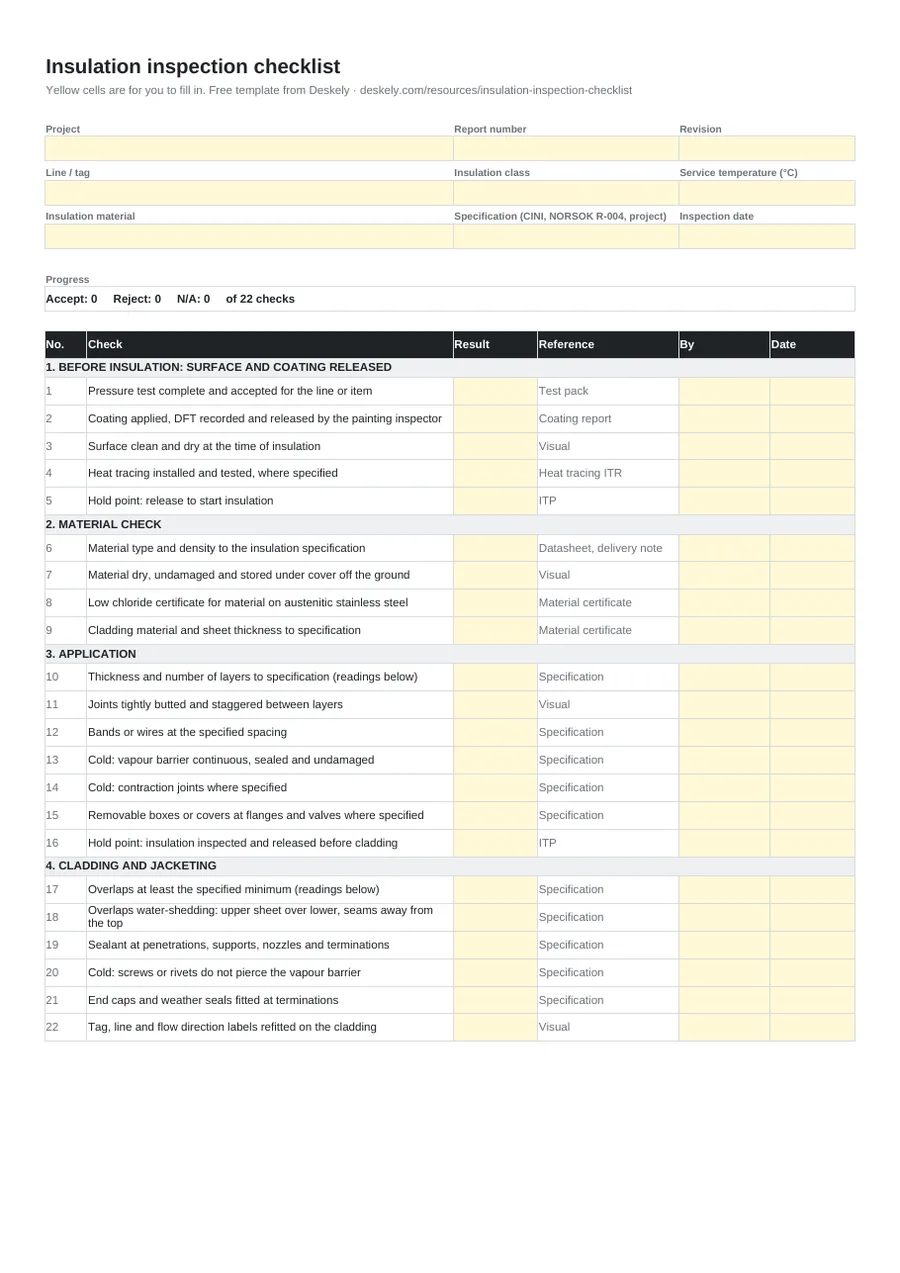
An insulation inspection checklist records that thermal insulation on piping and equipment was installed to specification, stage by stage: coating released before insulating, the right material and thickness, an intact vapour barrier on cold service, and cladding lapped to shed water and sealed at every penetration, with a hold point before the cladding closes it up.
This page gives you a free insulation inspection checklist in Excel and PDF, with thickness readings that flag anything below specification, an overlap check, and an inspection log for every line and item, and explains corrosion under insulation (CUI) and why the checks matter.
- Never insulate over coating that has not been inspected and released.
- Measure thickness at several points; one reading below specification is a reject.
- On cold service the vapour barrier is what keeps water out: no screws through it.
- Hold the work before cladding: once it is closed up, defects are invisible.
Why insulation is inspected: corrosion under insulation
Corrosion under insulation (CUI) is corrosion of the pipe or vessel wall beneath its insulation, caused by water that gets in through damaged cladding, open seams or unsealed penetrations and is then held against the steel. Because it is hidden, it is often found only when a line leaks.
Carbon steel is most at risk at operating temperatures of roughly −4 to 175 °C, the range used in API 583 and AMPP (formerly NACE) SP0198, and worst where the line cycles through wet and dry. Austenitic stainless steel can suffer chloride stress corrosion cracking under wet insulation, which is why insulation on stainless steel must be low in chlorides (tested to ASTM C795).
Most CUI starts with a defect an inspection could have caught: coating not released, a vapour barrier pierced, cladding lapped the wrong way, a missing sealant at a support. That is what this checklist is for.
The four inspection stages
- 01Surface and coating released
The line is pressure tested, coated, the coating is inspected and released, and the surface is clean and dry. Heat tracing is installed and tested where specified.
- 02Material check
Material type, density and thickness match the specification; material is dry and undamaged; low chloride certificates for stainless steel.
- 03Application
Thickness and layers to specification, joints butted and staggered, bands at the right spacing, and on cold service a continuous, sealed vapour barrier and contraction joints. Hold point before cladding.
- 04Cladding and jacketing
Overlaps at least the specified minimum (50 mm is common), lapped so water runs off (upper sheet over lower, seams away from the top), sealant at penetrations, end caps, and labels refitted.
The CINI manual and NORSOK R-004 are the references most often called up for industrial and offshore insulation. Take the thicknesses, overlaps and materials from your project specification.
Insulation classes
| Class | Purpose | What to watch |
|---|---|---|
| Hot | Heat conservation or process temperature control | Thickness, joints, water-shedding cladding |
| Cold | Prevent heat gain and condensation | Vapour barrier continuous and sealed; no fixings through it |
| Personnel protection | Keep touchable surfaces at a safe temperature | Coverage of every surface within reach |
| Acoustic | Reduce noise from piping and equipment | Layer build-up and mass layer to specification |
What is in the template
| Sheet | Fields |
|---|---|
| Inspection checklist | Project, report number, revision, line or tag, insulation class (Hot, Cold, Personnel protection, Acoustic), service temperature, material, specification, date. 22 checks in four stages with result, reference, by and date, and a progress count. Thickness readings (specified against measured, flagged if below), minimum and measured cladding overlap with a check, result, NCR or punch number, sign-off by contractor, client and TPI. |
| Inspection log | One line per line or item: service temperature, class, material, thickness specified and measured (flagged), vapour barrier intact, overlap (flagged against the project minimum), water-shedding, sealant at penetrations, hold point released, result, inspector, date. Counts of accepted, rejected and below-specification items at the top. |
Where insulation fits in the completions flow
Insulation comes after the pressure test and coating, and before mechanical completion: uninsulated joints are usually left open until the test pack is accepted. Insulation and coating repairs at test joints are a common line reinstatement item, and open insulation work is often a category B punch item.
Deskely Verify captures inspection and test records in the field and flags values outside range or tolerance before they are signed.
The Deskely products for this
Frequently asked questions
What is corrosion under insulation (CUI)?
Corrosion of a pipe or vessel beneath its insulation, caused by water trapped against the steel. Carbon steel is most at risk between roughly −4 and 175 °C.
What should an insulation inspection check?
That the coating was released before insulating, the material and thickness meet the specification, the vapour barrier is intact on cold service, and the cladding overlaps shed water and are sealed at every penetration.
What is the minimum cladding overlap?
It comes from the project specification. 50 mm is a common minimum for longitudinal and circumferential overlaps.
Which standards cover industrial insulation?
The CINI manual and NORSOK R-004 are widely used for piping and equipment insulation; ASTM C795 covers low chloride insulation for austenitic stainless steel.
Why is there a hold point before cladding?
Once cladding is fitted, thickness, joints and the vapour barrier can no longer be seen. The hold point lets the inspector release the insulation first.
- In production since 2014
- Thousands of daily users
- On MODEC FPSO projects since 2016