Preservation checklist and record: free equipment preservation template (Excel and PDF)
Deskely Completions team Singapore
Preservation keeps equipment in the condition it left the factory in, from delivery to start-up: shafts turned, heaters on, desiccant changed, covers and nitrogen blankets kept in place. On a long project equipment can sit for a year or more before it runs, and a missed routine can mean a seized bearing or a wet switchboard at commissioning.
This page gives you a free preservation register and record in Excel and PDF, with routines by equipment type and overdue flags, and explains how preservation is planned.
- Every tag that needs preservation has a routine, an interval and a next due date.
- Vendor preservation instructions come first; project procedures fill the gaps.
- Record each visit against the tag: what was done, the condition found, and who did it.
- Preservation responsibility moves with care and custody, so it must be clear at each handover.
What preservation covers
Preservation starts when equipment leaves the vendor and continues through storage, installation, mechanical completion and commissioning, until the system is in operation. In the Norwegian offshore industry it is covered by NORSOK Z-006, Preservation, revised in 2025; many operators and contractors write their own procedures on similar lines, always starting from the vendor's preservation instructions.
A preservation procedure defines, for each type of equipment, the routines to carry out, how often, and what to record. The register then lists every tag with its routine and interval, so the next due date and anything overdue are visible.
Typical routines by equipment type
| Equipment | Typical routines |
|---|---|
| Rotating (pumps, compressors, motors, fans) | Turn the shaft by hand to a new position so bearings and seals do not set; check oil levels or oil mist; keep breathers protected; keep space heaters energised; check covers and blanking. |
| Static (vessels, exchangers, columns, piping) | Check nitrogen blanket pressure where fitted; check flange covers, end caps and blinds; replace desiccant; check coatings and VCI (volatile corrosion inhibitor) protection; keep internals dry. |
| Electrical (switchboards, transformers, MCCs, motors) | Keep anti-condensation heaters energised and check they work; check enclosures are closed and sealed; replace desiccant; check cable entries are sealed; insulation resistance where the procedure asks for it. |
| Instruments (transmitters, analysers, valves and actuators) | Check caps and covers on process connections and cable entries; replace desiccant in enclosures; stroke or protect actuated valves as the vendor requires; keep sensitive items in controlled storage until installation. |
Intervals are commonly weekly, monthly or quarterly, set by the vendor and the environment: a yard in the tropics or an open deck offshore needs more frequent checks than a dry warehouse.
The template
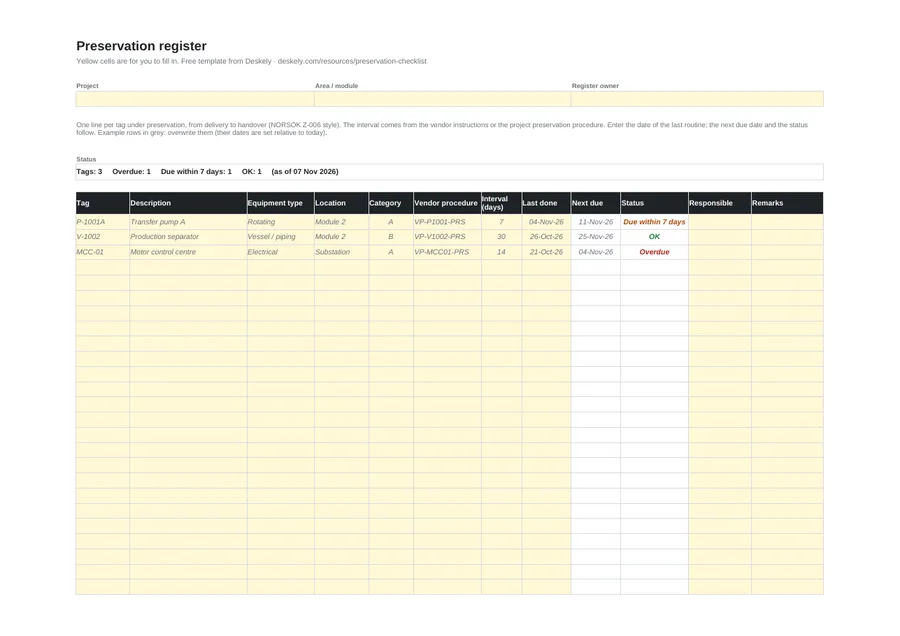
The register has one line per tag and routine: interval in days, last done, next due and an overdue flag worked out from today's date. The routine record is filled in on each visit, with the checks for the equipment type, the condition found and any punch item raised.
Preservation during completions
- At installation: preservation does not stop when equipment is set. Routines carry on in place, often with more work, such as heaters on temporary supply.
- At mechanical completion: preservation records are part of the evidence for the subsystem; open or overdue routines are often raised as punch items. See mechanical completion.
- At handover: whoever has care and custody owns preservation. The handover between construction, commissioning and operations must say who does each routine from that date.
- Removing preservation: before first run, preservation materials are removed as the vendor requires, for example flushing out preservation oil or removing desiccant bags, and recorded.
Preservation at scale
A large project has thousands of tags on preservation, each with its own routine and interval. A spreadsheet can show what is due; it cannot show who did it, or stop a routine being ticked without anyone visiting the equipment.
Deskely Core holds preservation tasks against the tag, alongside its inspections, punch items and certificates, from the yard to the field.
The Deskely products for this
Frequently asked questions
What is equipment preservation?
Keeping equipment in its as-delivered condition between delivery and start-up, with routines such as turning shafts, keeping heaters on, changing desiccant and maintaining nitrogen blankets.
What is a preservation record?
The record of each preservation routine carried out on a tag: the date, the checks done, the condition found and who did it.
Which standard covers preservation?
In the Norwegian offshore industry, NORSOK Z-006 (Preservation), revised in 2025. Elsewhere, company procedures based on the vendor's preservation instructions are the norm.
How often is equipment preserved?
As the vendor and the procedure set, commonly weekly, monthly or quarterly depending on the equipment and how exposed it is.
What goes in a preservation procedure?
The routines per equipment type, their intervals, who is responsible in each phase, how routines are recorded and how preservation is removed before start-up.
- In production since 2014
- Thousands of daily users
- On MODEC FPSO projects since 2016