Cause and effect matrix: how to read one, with a free template (Excel and PDF)
Deskely Completions team Singapore
A cause and effect matrix (C&E) is the table that defines what a shutdown, fire and gas or control system does: each row is a cause, such as a high-high pressure, each column an effect, such as closing a shutdown valve, and a mark where they cross means that cause triggers that effect.
This page explains how to read a cause and effect matrix, what the voting and trip columns mean, how the matrix is tested during commissioning, and gives you a free template in Excel and PDF with a worked example.
- Rows are causes (initiators); columns are effects (final elements).
- A mark at the crossing means the cause triggers the effect.
- Voting such as 2oo3 says how many sensors must agree before the trip.
- Every mark is tested during commissioning, and the test is recorded.
What is a cause and effect matrix?
In process plants, a cause and effect matrix is the specification of the safety and control logic in a form that operations, process, instrument and safety engineers can all read. It is used for emergency shutdown (ESD), process shutdown (PSD) and fire and gas (F&G) systems, and it is the basis for programming the safety instrumented system and for testing it.
The matrix is developed from the P&IDs, the HAZOP and the safety requirements specification, and kept under change control: changing a mark changes what the plant does in an emergency.
How to read one
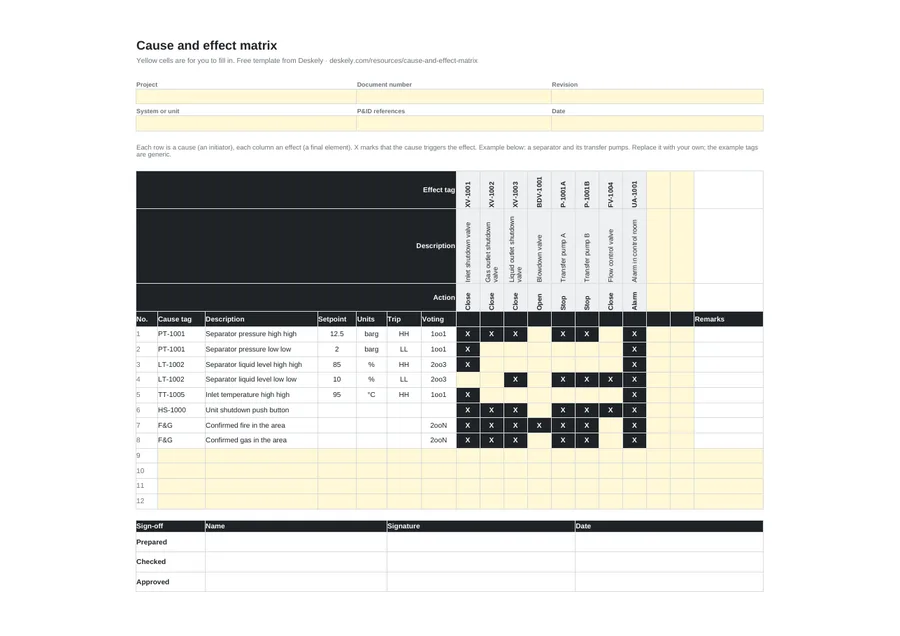
- Cause columns: the initiating tag, what it measures, the setpoint and units, the trip direction (HH high-high, LL low-low) and the voting.
- Effect columns: the final element tag, its description and the action it takes: close, open, stop, alarm.
- Marks: read along a row to see everything a cause does; read down a column to see everything that acts on an effect.
- Voting: 1oo1 trips on one sensor; 2oo3 trips when two of three sensors agree, which avoids spurious trips from one faulty transmitter.
In the example, a high-high separator pressure closes the inlet and both outlet shutdown valves, stops both pumps and alarms in the control room; a confirmed fire also opens the blowdown valve.
Testing the cause and effect
Each mark in the matrix is tested at least once before start-up: at the safety system FAT, then again on site during commissioning, ideally end to end from the real sensor to the real valve. The test record shows the cause applied, each effect observed and the response time where required.
C&E testing is one of the last commissioning activities before ready for start-up, and the records are reviewed in the pre-startup safety review.
Keeping the matrix and the tests in step
The matrix changes through the project as the design develops, and every change has to reach the safety system logic, the test procedures and the test records.
Deskely Sequence drafts commissioning procedures from the P&IDs and the system register, so the tests follow the current revision, and Deskely Delta shows which signed records a revision touches.
The Deskely products for this
Frequently asked questions
What is a cause and effect matrix?
A table showing which causes (alarms, trips, push buttons, detectors) trigger which effects (valves closing, pumps stopping, alarms), used to specify and test shutdown and fire and gas logic.
What does 2oo3 mean in a C&E?
Two out of three: the trip happens when two of three sensors reach the setpoint.
Who prepares the cause and effect matrix?
Usually the process and instrument engineers, from the P&IDs, HAZOP and safety requirements, with review by operations and safety.
How is a C&E tested?
By applying each cause and checking that every marked effect happens, at the system FAT and again on site during commissioning, with each test recorded.
- In production since 2014
- Thousands of daily users
- On MODEC FPSO projects since 2016