Lockout tagout (LOTO): what it is, the steps, the rules and a free procedure template
Deskely Completions team Singapore
Lockout tagout (LOTO) is the procedure that keeps machines and plant from starting up, or releasing stored energy, while someone is working on them. Every energy source is isolated, a personal lock and a tag are put on each isolation point, stored energy is released, and the isolation is tested before anyone touches the equipment.
This guide covers the steps, the types of hazardous energy, what OSHA and UK law require, how LOTO works during commissioning, and a free LOTO procedure template with a lock and tag register.
- Isolate every energy source, not just the electrical supply: pressure, stored and gravity energy kill too.
- One person, one lock, one key. Only the person who applied a lock removes it.
- Never skip the try-out: test for zero energy before work starts.
- Lockout control of hazardous energy is the third most cited OSHA standard (preliminary FY 2026 list).
What is lockout tagout?
Lockout means putting a lock on an energy isolating device, such as a breaker, a disconnect switch or a valve, so it cannot be operated until the lock is removed. Tagout means attaching a tag to it that warns the device must not be operated and names who applied it.
Lockout is the stronger of the two: a lock physically stops the device being operated, while a tag only warns. That is why OSHA allows tagout alone only where a device cannot be locked, or where the tagout gives the same protection as a lock.
In the US the rule is OSHA 29 CFR 1910.147, the control of hazardous energy. In the UK and Europe the same practice is usually called safe isolation, and in the process industries it sits inside the permit to work system.
Types of hazardous energy
| Energy | Examples | How it is isolated |
|---|---|---|
| Electrical | Motors, heaters, control circuits, capacitors | Breaker or isolator off and locked, fuses removed, earthed where required |
| Mechanical | Rotating shafts, belts, flywheels, conveyors | Drive isolated, parts blocked or restrained |
| Hydraulic | Presses, cylinders, accumulators | Pump isolated, pressure bled off, accumulators discharged |
| Pneumatic | Air actuators, receivers | Supply valve closed and locked, line vented |
| Process pressure | Lines and vessels with gas, steam or liquid | Valves closed and locked, blinds or spool removed, drained and vented |
| Thermal | Steam, hot oil, cryogenic lines | Isolated and allowed to reach a safe temperature |
| Chemical | Toxic, flammable or corrosive fluids | Positive isolation, flushed, purged and gas tested |
| Gravity and stored | Raised loads, springs, counterweights | Lowered, blocked or pinned |
The lockout tagout steps
- 01Prepare
Read the energy control procedure for the equipment and identify every energy source and its magnitude.
- 02Notify
Tell the operators and everyone affected that the equipment will be shut down and locked out.
- 03Shut down
Stop the equipment by its normal stopping procedure.
- 04Isolate
Operate each energy isolating device: open breakers, close valves, disconnect drives.
- 05Lock and tag
Each worker puts a personal lock and a tag on every isolation point, or on a group lockbox.
- 06Release stored energy
Bleed, vent, drain, discharge capacitors, block or lower anything that can move.
- 07Verify
Make sure no one is exposed, try the normal start controls, and test for absence of voltage and zero pressure. Return the controls to off.
- 08Work, then restore
When the work is done, clear tools and people, refit guards, and each person removes their own lock before the equipment is restarted.
Free LOTO procedure template
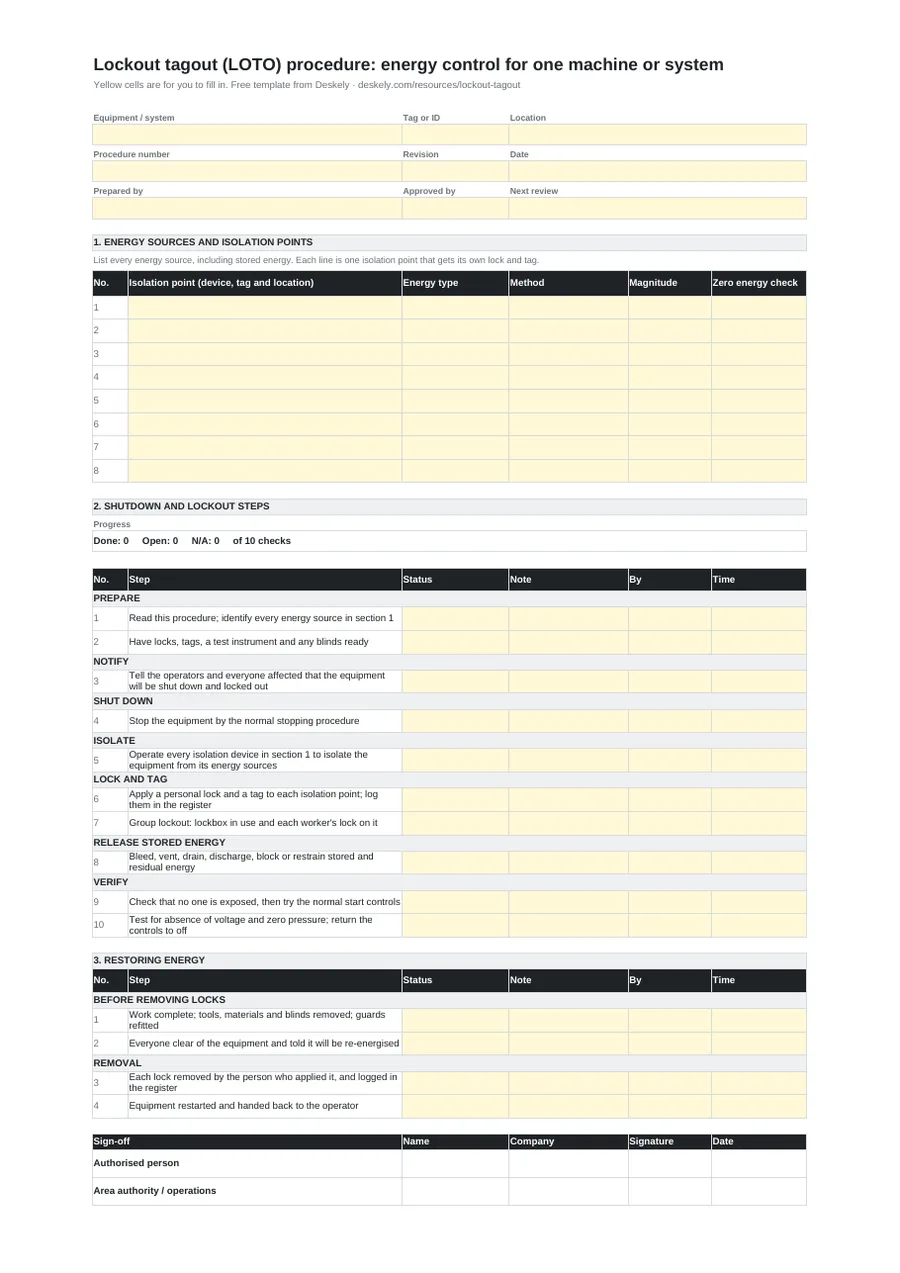
- Energy control procedure: equipment, tag and location; every isolation point with its energy type, method, magnitude and how zero energy is checked; the shutdown, lockout and verification steps with a status per step; restoring energy; and sign-off.
- Lock and tag register: one row per lock, with lock and tag numbers, isolation point, who applied, verified and removed it, times on and off, and a live status.
- Drop-downs for energy type, isolation method and status. Download it and adapt it to your own procedure.
What OSHA 1910.147 requires
The OSHA standard applies to servicing and maintenance in general industry, where unexpected start-up or release of energy could injure workers. An employer must have an energy control program with:
- Written procedures for each piece of equipment, with the steps to shut down, isolate, block, secure and verify, and to remove locks.
- Lockout and tagout devices that are durable, standardised, substantial enough not to be removed without excessive force, identify the person who applied them, and are used for nothing else.
- Training: authorised employees learn to recognise energy sources and to isolate them; affected employees learn what the procedure is and never to restart locked-out equipment.
- Periodic inspection of each procedure at least once a year, by an authorised employee other than those using it.
- Rules for special cases: group lockout, shift changes, outside contractors, and removing a lock when the person who applied it is not available.
Construction and electrical work are covered by other OSHA rules (including 1926 subpart K and 1910 subpart S), and NFPA 70E sets out how to create an electrically safe work condition.
Lockout tagout in the UK and Europe
UK law does not use the term lockout tagout, but the duty is the same. The Provision and Use of Work Equipment Regulations 1998 require means to isolate equipment from its energy sources, and the Electricity at Work Regulations 1989 require dead working wherever possible, with precautions against equipment being made live. HSE guidance HSG253, the safe isolation of plant and equipment, sets out isolation standards for the process industries.
In Europe, EN ISO 14118 covers the prevention of unexpected start-up of machinery, and in Canada CSA Z460 covers the control of hazardous energy.
Lockout tagout during commissioning
Commissioning is when isolation is most complicated. Systems are energised for the first time, construction and commissioning crews work side by side, and the boundary between a live system and one still being built moves every day.
- Isolate by system. Isolations follow the system and subsystem boundaries of the completions plan, so everyone knows which part of the plant has been handed to commissioning.
- Energise under control. First energisation of a switchboard or a process system is a planned event with its own procedure, after the system has passed mechanical completion.
- One isolation register. Commissioning keeps a single register of every isolation, lock and permit, transferred to operations at handover.
- Permit to work. On process plants and offshore, LOTO sits inside the permit to work system, with isolation certificates per job.
See mechanical completion, the pre-startup safety review and commissioning 101 for the steps around it.
Common lockout tagout mistakes
- Isolating the electrical supply and forgetting stored, pressure or gravity energy.
- Skipping the try-out, so a failed isolation is only found when someone is already inside.
- One lock for a whole crew instead of a personal lock per worker or a group lockbox.
- Tags used where a lock would fit, or tags without a name and date.
- Procedures that are generic rather than written for the actual equipment, and never reviewed.
- Locks cut off at shift change instead of being transferred under the procedure.
The Deskely products for this
Frequently asked questions
What does LOTO stand for?
Lockout tagout: isolating equipment from its energy sources and fitting locks and tags so it cannot be started or re-energised while someone works on it.
What are the steps of lockout tagout?
Prepare, notify, shut down, isolate, lock and tag, release stored energy, verify zero energy, and finally restore energy with each person removing their own lock.
What is the difference between lockout and tagout?
A lock physically stops an isolating device being operated; a tag only warns. Tagout alone is allowed only where a device cannot be locked, or gives equal protection.
Who can remove a lockout lock?
Only the person who applied it. If that person is not available, OSHA allows removal only under a written procedure: verify they are not at the site, try to reach them, and tell them before they return to work.
How often must LOTO procedures be inspected?
At least once a year under OSHA 1910.147, by an authorised employee other than those using the procedure.
What is the OSHA standard for lockout tagout?
29 CFR 1910.147, the control of hazardous energy, for general industry.
Is there a free lockout tagout template?
Yes. Download the Excel or PDF template on this page: an energy control procedure for one machine or system and a lock and tag register.
- In production since 2014
- Thousands of daily users
- On MODEC FPSO projects since 2016