Surge arrester symbol
Also called Lightning arrester, Surge diverter
A surge arrester conducts to earth when the voltage rises above a set level, clamping lightning and switching surges to protect the insulation of equipment.


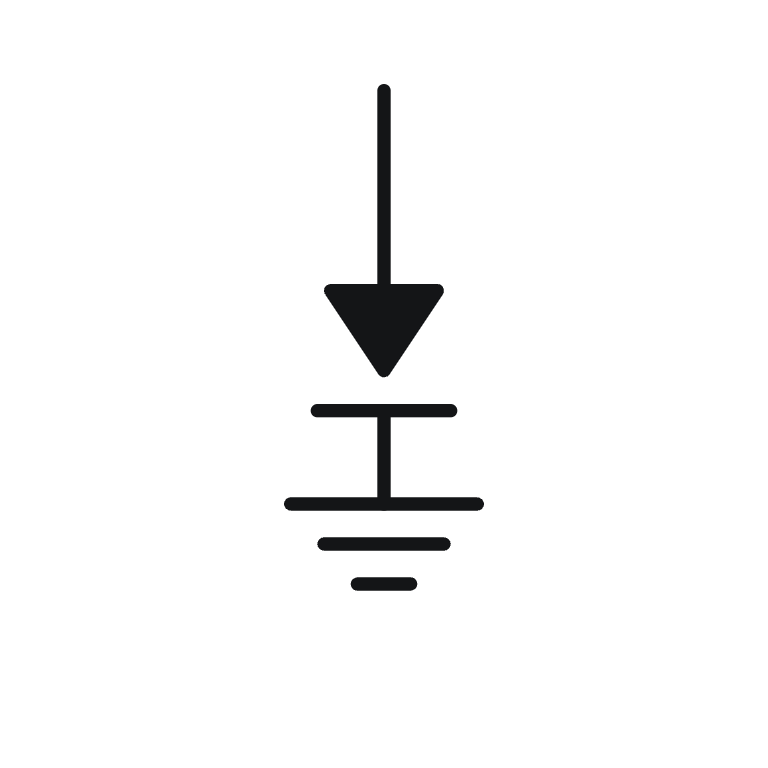
What the surge arrester symbol means
A surge arrester conducts to earth when the voltage rises above a set level, clamping lightning and switching surges to protect the insulation of equipment.
ANSI and IEC symbols
An arrow pointing to a gap, connected to ground. Drawings vary, so check the legend.
ANSI SVGWhere you see it
At transformer terminals, cable terminations, overhead line entries and motor terminals.
What is written next to it
On a one-line, the surge arrester carries its tag and its ratings: rated voltage, continuous operating voltage (MCOV) and nominal discharge current.
What gets checked at commissioning
Before the surge arrester is energised, the test records usually cover: insulation resistance or leakage current, and the earth connection. Each check is recorded against the tag, so the system can be handed over with its evidence. See commissioning software.
Related symbols
Frequently asked questions
What does the surge arrester symbol look like?
On ANSI drawings: An arrow pointing to a gap, connected to ground. Drawings vary, so check the legend. In IEC 60617: A rectangle with an arrow pointing down inside it, connected to earth.
Is the surge arrester symbol the same in IEC and ANSI?
No. A rectangle with an arrow pointing down inside it, connected to earth. The IEC 60617 number is S00373.
Where is a surge arrester used?
At transformer terminals, cable terminations, overhead line entries and motor terminals.
- In production since 2014
- Thousands of daily users
- On MODEC FPSO projects since 2016