System and subsystem register: free systemisation template (Excel and PDF)
Deskely Completions team Singapore
Completions and commissioning are planned and certified by system and subsystem, not by area or discipline. The system and subsystem register lists them all, with the dates each one must reach mechanical completion, ready for commissioning and ready for start-up, and how close each one is.
This page gives you a free system and subsystem register in Excel and PDF and explains systemisation: how the facility is split, how systems are usually numbered, and why the register drives the plan.
- A system is a function of the plant; a subsystem is the smallest part that is completed, tested and handed over on its own.
- Every tag belongs to exactly one subsystem, and the boundaries are marked on the drawings.
- Target dates for MC, RFC and RFSU are set per subsystem, in commissioning order.
- Open ITRs and punch per subsystem are what decide whether the dates hold.
What is systemisation?
Systemisation splits the facility into systems and subsystems. A system is defined by function: seawater lift, fuel gas, instrument air, a 690 V distribution board. A subsystem is the smallest part of a system that can be completed, tested and handed over on its own, such as one pump train with its piping, or one switchboard section with its feeders.
Each tag on the P&IDs, single line diagrams and cable schedules is assigned to one subsystem, and the boundaries are drawn on marked-up drawings (often called systemisation or limit drawings). From then on, ITRs, punch items, test packs and certificates are counted per subsystem. See commissioning 101.
How systems and subsystems are numbered
Most owners have a coding standard that fixes the system numbers for every facility, so the same number means the same function on every project. Subsystems then add a suffix to the system number. A typical pattern:
| Level | Example | Meaning |
|---|---|---|
| System | 40 | Seawater system, from the company coding standard |
| Subsystem | 40-01 | Seawater lift pump A, with its suction and discharge piping |
| Subsystem | 40-02 | Seawater lift pump B |
| Subsystem | 40-03 | Seawater distribution header and filters |
Some projects add a facility or module prefix, or a discipline letter for subsystems that are purely electrical or instrument. Whatever the format, keep it fixed once ITRs and punch are being raised against it, because every record carries the number.
The template
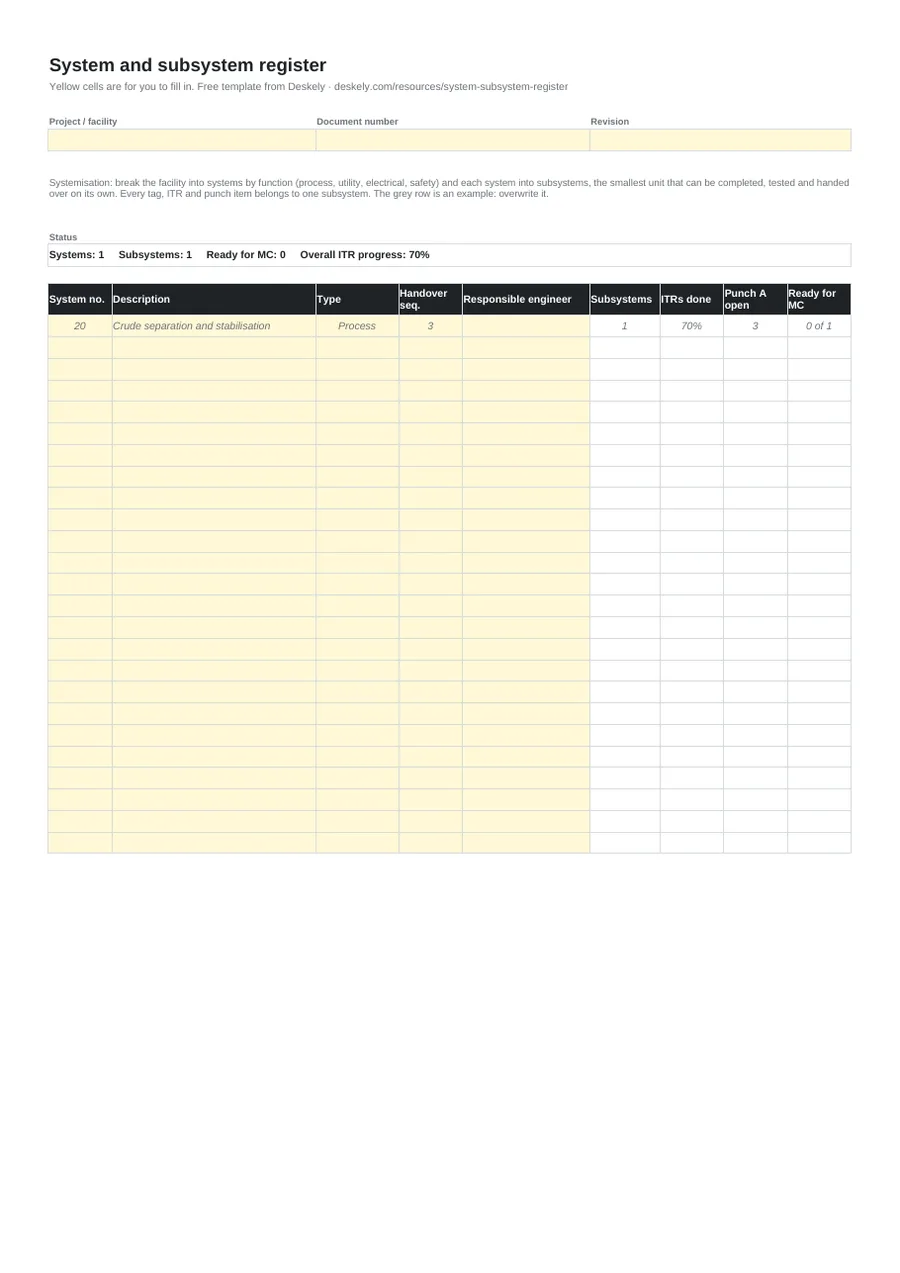
The systems sheet lists each system with its description and the subsystem counts rolling up from below. The subsystems sheet has one line per subsystem: parent system, description, boundary drawing, MC, RFC and RFSU target dates, ITRs total and signed, punch A and B open, percent complete, and a ready for MC status that turns on when every A ITR is signed and no A punch is open.
Why the register drives MC and handover
- Commissioning order: utilities first (power, instrument air, seawater, cooling), then the process. The register's target dates follow that order, back-scheduled from start-up.
- Mechanical completion: construction completes by subsystem, not by area, so the subsystems commissioning needs first are finished first. See completion certificates.
- Progress: ITRs signed and punch closed per subsystem are the honest measure of progress, and feed the S-curve.
- Handover: each subsystem's certificates and records make up its handover dossier. See the handover dossier template.
The register only works if the tag list behind it is right. Start from the equipment list and the line list, and see the ITR guide and punch list template for the records counted against each subsystem.
From register to live status
In a spreadsheet the counts are typed in each week. In Deskely Core every ITR, punch item, test pack and certificate is held against its tag, so completion status by tag, subsystem, system and facility comes from the records themselves.
The Deskely products for this
Frequently asked questions
What is the difference between a system and a subsystem?
A system is a function of the plant, such as seawater or fuel gas. A subsystem is the smallest part of it that is completed, tested and handed over on its own, such as one pump train.
What is systemisation?
Splitting the facility into systems and subsystems, assigning every tag to one subsystem and marking the boundaries on the drawings, so completions and commissioning can be planned and certified per subsystem.
How are subsystems numbered?
Usually the system number from the owner's coding standard, plus a suffix: system 40, subsystems 40-01, 40-02 and so on. Projects often add a facility or module prefix.
Who owns the system and subsystem register?
The completions or commissioning team, who set the boundaries with engineering and keep the register under revision control.
- In production since 2014
- Thousands of daily users
- On MODEC FPSO projects since 2016