Start-up checklist: free start-up readiness checklist with Go / No-Go decision (Excel and PDF)
Deskely Completions team Singapore
A start-up readiness checklist is the final Go / No-Go check before a commissioned system is started with its process medium, confirming that procedures are issued, operators trained, category A punch closed, the PSSR done, safety systems tested, isolations cleared and utilities available, and recording the decision with signatures.
This page gives you a free start-up readiness checklist in Excel and PDF, with 15 requirements, a punch line that turns No-Go if any category A item is open, an overall decision that fills in by itself, and a register that shows the decision for every system.
- One No-Go on any requirement means the system does not start.
- Category A punch open on the system must be zero; the template checks it for you.
- The PSSR and the RFSU certificate come before the Go decision, not after.
- Operations signs the decision, because operations will run the system.
Where the start-up checklist sits
- 01Mechanical completion
The system is built and inspected; category A punch is closed for MC.
- 02Ready for commissioning (RFC)
Pre-commissioning is done and the subsystems may be energised or filled.
- 03Commissioning
Function tests, cause and effect tests and run-in with the real medium.
- 04Pre-startup safety review (PSSR)
A team review that the system was built and commissioned as designed and is safe to start.
- 05Ready for start-up (RFSU)
The certificate that the system is safe to introduce hydrocarbons or its process medium.
- 06Start-up readiness (Go / No-Go)
The last check on the day: everything the RFSU relies on is still true, and the people and supplies are in place.
The RFSU is a certificate signed once. The start-up checklist is run close to the start, because things change between the two: a permit reopened, a relief valve removed for repair, a punch item raised on a late walkdown.
The Go / No-Go requirements
| Group | Requirement | Typical evidence |
|---|---|---|
| Procedures and people | Start-up and operating procedures issued; operators trained; emergency response updated and drilled | Procedure numbers, training records, drill record |
| Completions | Category A punch open = 0; RFC certificates signed; PSSR done and pre-start-up actions closed | Punch list, certificates, PSSR report |
| Safety systems | ESD tested; fire and gas detection tested; cause and effect tested end to end; relief valves set and certified | Test records, PSV certificates |
| Isolations | Permits closed, LOTO removed or handed to operations; temporary blinds and test equipment removed | Isolation and spade registers |
| Utilities and supplies | Power, instrument air, nitrogen and cooling water available; spares, lubricants and chemicals in place; communications working | Utility status, first fill record, telecom ITRs |
In the United States, OSHA 29 CFR 1910.119(i) requires a pre-startup safety review for new and significantly modified facilities covered by process safety management. Many operators apply the same discipline everywhere.
What is in the template
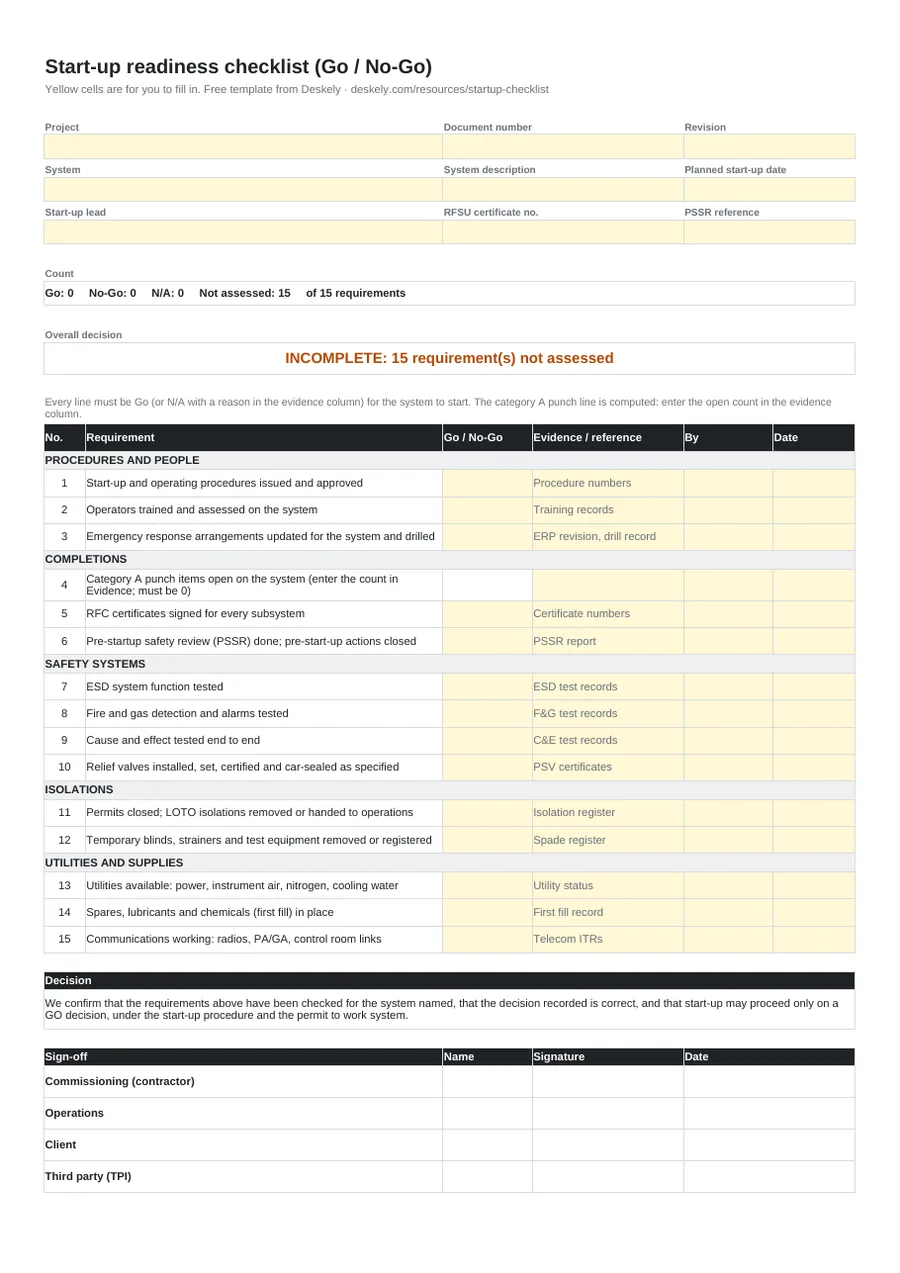
| Sheet | Fields |
|---|---|
| Start-up readiness | Project, document number, revision, system, description, planned start-up date, start-up lead, RFSU certificate number, PSSR reference. Count line and overall decision (formula). 15 requirements with Go / No-Go / N/A (drop-down), evidence, by and date; the punch line computes Go or No-Go from the open count. Decision statement and sign-off by commissioning, operations, client and TPI. |
| Readiness by system | One line per system: punch A open, RFC signed, PSSR done, ESD and F&G tested, C&E tested, procedures issued, operators trained, LOTO cleared, utilities available, decision (formula: Go, No-Go or Incomplete), planned start-up and remarks. Counts at the top. |
How it connects to the other records
The checklist is only as good as the records behind it. The PSSR checklist covers the safety review itself, the completion certificates include the RFSU certificate, and the cause and effect matrix and lockout tagout procedure cover two of the checks in detail.
Deskely Core holds the tag register, ITRs, punch and handover in one system of record, so the punch and certificate lines can be read from the records instead of counted by hand.
The Deskely products for this
Frequently asked questions
What is a start-up checklist?
The final Go / No-Go check before a commissioned system is started with its process medium, confirming procedures, training, punch, PSSR, safety systems, isolations and utilities are all in place.
What is the difference between RFSU and a start-up checklist?
RFSU is the certificate that a system is ready for start-up. The start-up checklist is run close to the actual start, to confirm nothing has changed since the certificate was signed.
Can a system start with open punch items?
Not with category A items open. Category B items may remain if they are listed, agreed and do not affect safe operation.
What is a PSSR?
A pre-startup safety review: a team check that a new or modified system was built and commissioned as designed and is safe to start. OSHA 1910.119(i) requires one for covered processes in the US.
Who makes the Go / No-Go decision?
The start-up lead with operations, commissioning and the client, each signing the checklist.
- In production since 2014
- Thousands of daily users
- On MODEC FPSO projects since 2016